Rancher Talk

Have your heifers started?  Did you have to pull very many?  When do the cows start?  All these questions are beginning to circulate between ranching neighbors at this time of year.  Have you heard any of this lingo and wonder, what in the world are they talking about?  This is a very important at this time for Sublette County because much of the rural population is ranchers.  Let’s take a minute and find out what all this means.

Hereford calves rest in the sunshine during calving season in Sublette County Wyoming.

During these spring months ranchers begin calving season.  If you have never lived in a ranching community, some of the conversations can be confusing and jaw dropping if you do not understand the way of life or even the language. 

Have your heifers started? Many ask this question to see if you started calving yet.

Did you have to pull very many? Is a question neighbors use to judge if you are having a difficult or fairly easy calving season. 

When do the cows start? This is just another way of asking if you are close to being finished or are you just starting the season.

What is a heifer you may ask?  They are cows that are having their first calf.  Many heifers, just like humans, have trouble their first time so the ranchers have to watch them fairly close.  All ranches are different, but many get up during the night to check on their heifers.  Some operations have enough people to take shifts through the night and others are not so lucky.  They all have to manage to function and perform the everyday ranch chores even if they are dead tired from being up all night with a heifer calving.
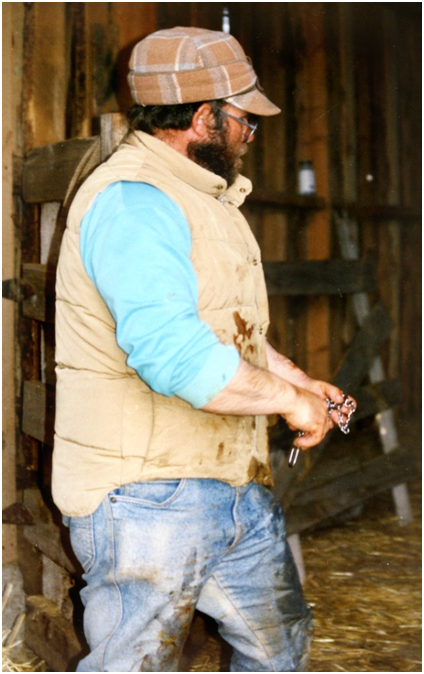
Sublette County Rancher Albert Sommers prepares to pull a calf during calving season in Wyoming.
Sublette County Rancher Albert Sommers getting ready to pull a calf by putting a chain on the calf’s feet and hooking to pullers. When the mother is struggling to give birth, this is the safest way for both the mother and calf to get through the complication.

During the heifer checks, ranchers are looking for a heifer that is having trouble giving birth.   If it is needed the rancher assists her by using a puller, or in certain situations they may have to call a veterinarian to perform a caesarian (c-section).  The puller is a tool that is used to help pull the calf out quickly and safely.  Every situation is different just like human births.
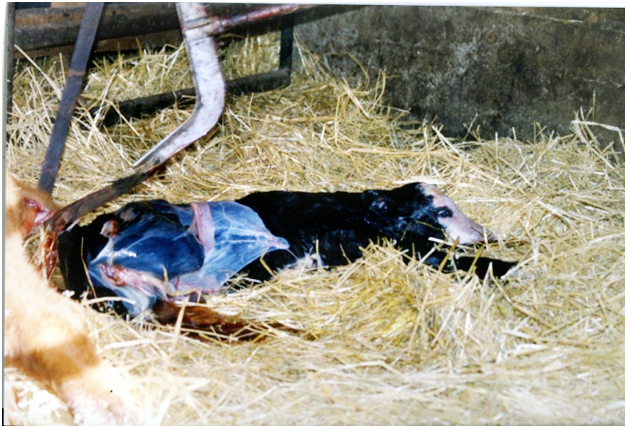
Calf just pulled from the mother cow by a rancher with pullers.
This calf had to be pulled from it's mother by Albert to ensure both the calf and mother survived.

You will hear people talk about their cows.  In general, the word cows and cattle are interchangeable but not in this context. The cows are female cattle that have had more than one calf.  They can range from three years old to 10 years or older depending on the operation.  Each operation is its own business, so they all have their own system of keeping and culling cows.  When a cow is culled it means, the cow is too old or no longer needed and is removed from the herd by selling it.

Cows are more experienced at giving birth, but there are still times they need help. A couple of times a day the rancher will check on the cows, tag the new calves and make sure the cows have cleaned.  This means the after birth or placenta has been completely removed from the body of the cow.  If she has not cleaned or has prolapsed the rancher has to bring her in to the corral.  Once she is corralled she will be given antibiotics to help fight infection or fix the prolapsed cow. When a cow is prolapsed it means that the uterus slips or falls out of place.  It is not a pretty sight and it is not a fun job to fix.  Just like all jobs, ranching has its fun duties and not so fun duties.
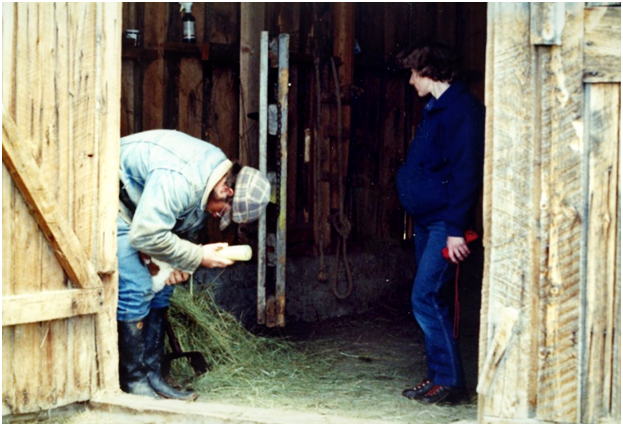
Sublette County rancher Albert Sommers bottle feeds a calf during calving season in Wyoming.
Albert bottle feeds this calf with milk before reuniting the baby with the mother cow.

Nothing is more exciting than spring, even though calving can be mentally and physically demanding work. Many wonder why ranchers do it.  Well if you have ever had a new puppy and it became the prized family pet, you will get a small sense of the strong love ranchers have for their cattle.

Wyoming Hereford calf nurses from its mother during calving season.

Don’t be afraid to ask questions if you overhear someone talking about calving or other ranching topics. We learn from each other every day. Understanding the language of our neighbors is the first step to understanding our neighbor’s actions.

From RealRancher Kari Bousman – Boulder, Wyo.

Photos by RealRancher Jonita Sommers – Pinedale, Wyo.

All work & no play makes a rancher dull

It’s not all work…sometimes we have fun too.

Winter on our place usually means feeding the cows day after day in snow that seems to get deeper and deeper.

However, with deep snow comes opportunity.  Timmery, my wife, and I like to take a few hours from time to time and go up in the mountains and have fun.

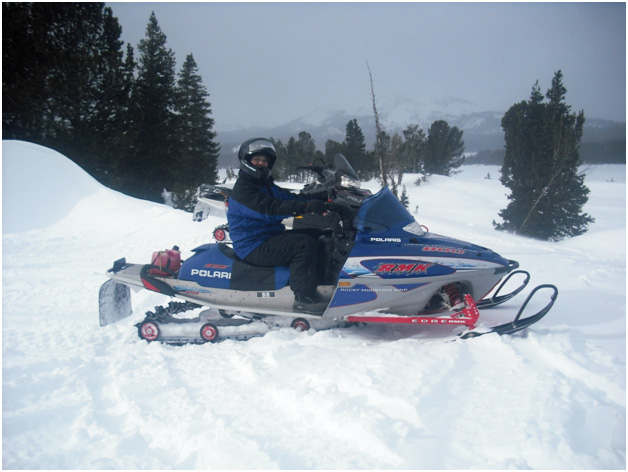
RealRanchers Jim and Timmery Hellyer from Lander, Wyo. take a break from feeding their beef cattle to snowmobile.

That’s Timmery on her machine (called a sled) at Christina Lake in the Wind River Mountains above Lander, Wyo.

Sometimes the snow doesn’t have a decent base or the snow machine driver goes to slow or whatever, and then….

RealRanchers Jim and Timmery Hellyer from Lander, Wyo. take a break from feeding their beef cattle to snowmobile.

The machines get stuck.  Just as Timmery did in the above picture.  She always tells me that is why she married me…so I can help her get unstuck.  I get stuck plenty too.

A typical day of fun with snowmachines involves going to your local gas station and pouring money into the gas tank of a machine that will break down at least once a year.  Then a short drive to the parking lot to unload.

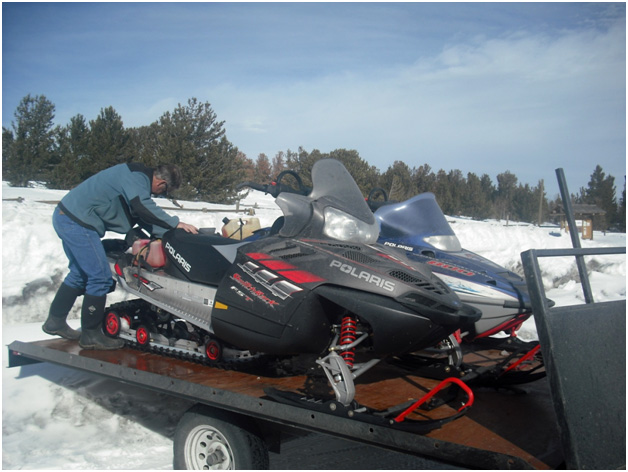
RealRanchers Jim and Timmery Hellyer from Lander, Wyo. take a break from feeding their beef cattle to snowmobile.

Here I am strapping down an extra gallon of “just get me back to the pickup.”

After a dozen or so miles of groomer trails you can usually find some untracked hills or parks to ride through.  This is what it is all about….fun in the deep snow.

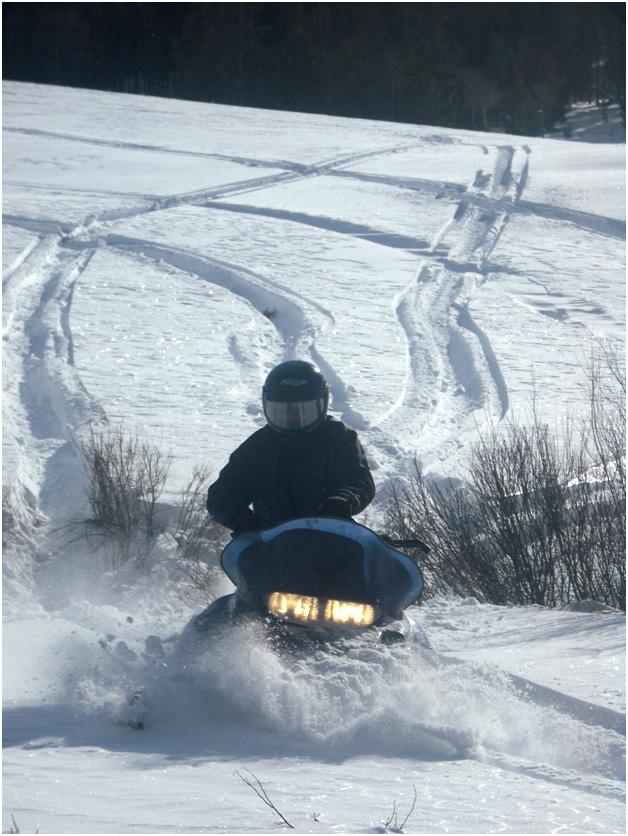
RealRanchers Jim and Timmery Hellyer from Lander, Wyo. take a break from feeding their beef cattle to snowmobile.

That’s Timmery on the gas after crossing a little creek “somewhere” last weekend.  It is a “somewhere” because it is a secret spot only known by us and several thousand other locals.

When the gas gauge says it is time to quit we head for home.  Sometimes we pause and take a picture to share with everyone.  Then it is back to work.

RealRanchers Jim and Timmery Hellyer from Lander, Wyo. take a break from feeding their beef cattle to snowmobile.

From RealRancher Jim Hellyer – Lander, Wyo.

The Gal Behind the Curtain

You know how in the Wizard of Oz when Dorothy gets really curious about what’s going on behind that curtain as she and her crew are talking to the giant head of the wizard? He said, “Pay no attention to the man behind the curtain!” He was making magic happen and didn’t want it spoiled.

Just as in the Wizard of Oz, there is always someone behind the curtain at www.realranchers.com

Well folks, I hate to spoil the magic, but I must reveal that I am the (wo)man behind the curtain of RealRanchers.com. I’m only exposing my identity because I don’t want you to think RealRanchers.com has abandoned you for the next two weeks.

Wyoming Stock Growers Association Outreach Coordinator
Here I am, Liz LeSatz, being revealed as the gal behind the scenes of RealRanchers.com (I was hiding in a trunk, not behind a curtain, I am WAY tougher than that wimpy wizard). However, I don't always look like Tony Soprano got me.

We have a great system here at RealRanchers.com. Our talented ranchers and rural community members send their posts to me and I pop them online. Not that I’m a control freak (well, I am, but that’s not the reason for the system). It’s just faster and easier for our contributors who are busy caring for their livestock, stewarding their land and keeping rural Wyoming humming.

RealRanchers.com contributors, the Bousmans, are great stewards. They monitor their land to make sure they are properly grazing (not too much and not too little).

But for the next two weeks I will be absent from the blogosphere due to a little custom we call a wedding. That’s right folks, one of Wyoming’s finest stole my heart five years ago and we’re tying the knot on Jan. 8!

Liz is getting married to a farmer!
Liz & Tyler. Tyler farms sugar beets, corn, pinto beans and barley in Wyoming. Photo by Double H Photography

For the next two weeks I won’t be posting the fun, interesting and informative material you’ve come to love and expect from RealRanchers.com due to my need to plan the final details (control freak again) and go on a honeymoon.

Is that a tear I see? Don’t cry, fret, wring your hands or break out the Ben & Jerry’s just yet! Because as Dorothy so wisely stated, “There’s no place like home.” I’ll be back before you know it and we’ll be in full swing again bringing you gems like this…

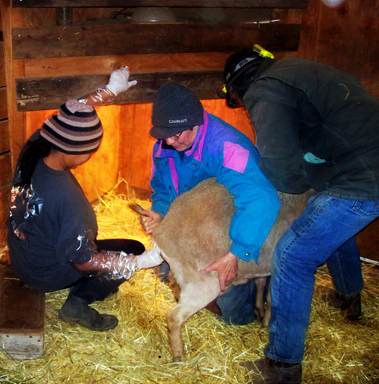
Native filipino and RealRancher Lovella Dawn Price pulls a kid goat when its mother had trouble during birthing.

In the meantime, be sure to check out some of these great Wyoming agriculture blogs and we’ll be seein’ ya next year!

Heather Hamilton

The Real Life of a Ranch Hand’s Wife

Pat & Sharon O’Toole

Red Dirt In My Soul

Happy New Year!

From RealPartner Liz LeSatz – Wyoming Stock Growers Association

Chicken Broods

Peep! Peep! Peep! is all you hear on the other end of the phone before the Postmaster says in a very excited voice, “I have a box of chicks for you. You can come anytime. Just knock on the back door.” After rushing to town, the chicks are brought home.

RealRancher Jonita Sommers discusses caring for chickens and baby chicks including feeding them anitibiotics.
Jonita Sommers picks up her chicks at the post office! She puts a little animal antibiotic in the water to help keep the chicks healthy after their stressful journey.

There are at least 25 because the hatchery will not ship less than twenty-five chicks. A heat lamp is hooked up and a jar of water with antibiotic is fixed so the chicks can drink. There is dirt put in the bottom of the box with some chick start feed. The chicks must eat dirt, so their craw and digestive system works correctly.

RealRancher Jonita Sommers discusses caring for chickens and baby chicks including why chickens eat dirt.
These hens are eating feed and dirt, which helps keep their digestive system functioning properly.

Each little chick is taken from the box and their little beak is dipped in the water a couple of times so they each have a drink. They are each set in the box of dirt and feed to eat. After an hour, they are put back in the box to sleep. This is repeated two more times the first day. If there is a sick chick, the chick is removed, wrapped in a blanket and put under the heat lamp by itself. If a chick gets sick it usually dies. It is live or die with them.

RealRancher Jonita Sommers discusses caring for chickens and baby chicks including feeding them anitibiotics.
As the chicks grow their mother hen continues to carefully care for them.

A setting hen is brought from the chicken house and put in the coup with two little chicks at night. If the two chicks are alive in the morning, the hen has accepted them. She is given the rest of the brood. A big hen can take care of 25 chicks. The heat from her body will keep the chicks warm. The chicks are darling when they sit on top of the hen. They think they are so wise when they manage to hop up on the hens back and perch there.

RealRancher Jonita Sommers discusses caring for chickens and baby chicks including hooking the chicks onto a mother hen.
The baby chicks like to hang out with (and hang on) their new mother.

When they get old enough and the weather permits, you can let them out of the coup. When the coup door is opened, the chicks dart out flapping their wings. The old hen puffs up and starts clucking in hopes she can keep them under control.

RealRancher Jonita Sommers discusses caring for chickens and baby chicks. These chickens could be considered "free range chickens."
The mother hen does her best to control her brood and make sure these free roaming chickens are kept away from the many predators they are susceptible too.

From RealRancher Jonita Sommers – Daniel, Wyo.

Sausage and other career opportunities

Thirty-two 4-H youth from Niobrara, Natrona and Converse counties took part in a three day retreat at the University of Wyoming campus, Nov. 19 -21. This three day retreat was part of the Wyoming Youth Leadership Education program which is currently focusing on career and workforce preparation.

Wyoming 4-H Students participate in a weekend educational experience at the University of Wyoming, Wyoming's only four-year higher learning institution.

The retreat began with a full campus tour, giving youth a quick look at college life in both the living dorms and educational facilities. Members were then given the opportunity to tour various colleges and have a more in-depth look at areas in which they would like to study. Various colleges participating were Agriculture and Natural Resources, Engineering, Arts and Sciences, Commerce and Industry (business), Nursing and the Wyoming State Veterinary Lab.

Youth also had several workshops with inspiring speakers. Topics of these workshops included communication in the work place, developing a resume and preparing for job interviews. A major highlight for the group was a panel of current college students, who were previously 4-H members from these three counties. Youth gained a lot of “common sense” information about college life including roommates, budgeting, studying and balancing all aspects of college life.

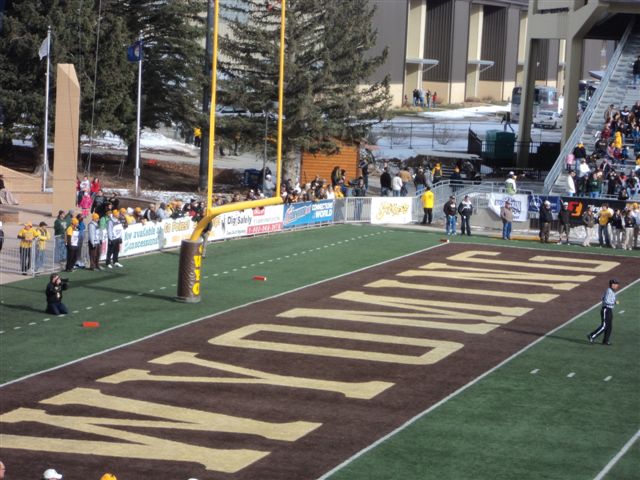
The delegation had the opportunity to attend the Animal Science Department tailgate party prior to attending the Wyoming v. Colorado State University football game, which was a fun and exciting part of the entire college experience. YEAH!!! We get the boot two years in a row!!!

When the U of Wyoming and their rival Colorado State U play against eachother, we call it a "border war."

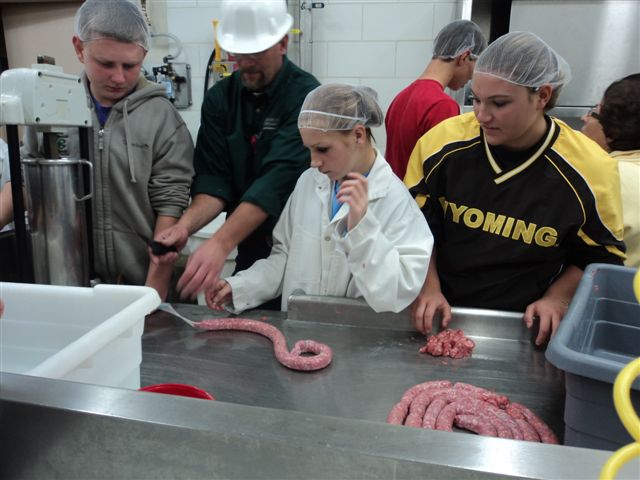
Finally, the group had a small taste of a college laboratory experience, as Dr. Warrie Means, Animal Science Professor, had youth make five different kinds of sausage.

Blending the sausage meat and spices together.
Making sausage with a great professor, Dr. Means

After making the sausage and stuffing it into links, youth got to cook and sample their product, just like the college Meat Processing class students take every fall.

It truly was a college weekend experience!

From RealPartner Tammie Jenson, Niobrara County 4-H/Youth Director

Just Feedin’ Cows…and Deer!

Things have slowed down on the ranch now.  We aren’t pushing cows and we aren’t shipping cows, that’s all over with.  Now it’s time to settle in for the winter.  Most of our time is spent feeding the cattle and finishing or starting odd projects around the place that need doing.  We’ve made it through pregnancy testing and weaning so now we have about three separate herds of cattle at home.

The first herd is the weaned calves. We feed the weaned calves all winter so they can continue to grow into nice, fat yearlings. They will then go up the Green River on next summer’s drive and come down again in the fall to either be sold or kept as replacement stock.  The second herd is the first-calf heifer herd; the heifers that will have their first calves this coming spring.  We like to keep them separate so we can feed them well and watch them closely.  They are not only growing a new baby calf they are also still growing themselves so it is important they receive a little extra nutrition than older cows.  Finally, we have the main cow herd, consisting of cows that have all had at least one calf in the past.

Early in the winter we feed the first-calf heifers and cows supplement.  There is still lots of grazing available on the ranch and the cows can forage and do quite well, but they need some extra supplemental protein (usually in the form of pellets) to be able to better digest the grass available.  Once the grass is grazed to a level that is healthy for the grasslands or the snow becomes too deep, whichever comes first, we start feeding the hay we grew and bailed in the summer.  As for the calves that have been weaned, we start feeding them hay and supplement right at weaning time.

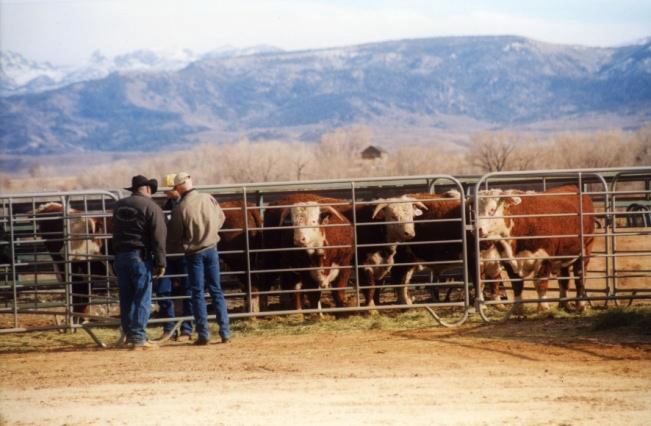
Here we've just finished feeding the cows their supplement and they are busy licking up every last speck.

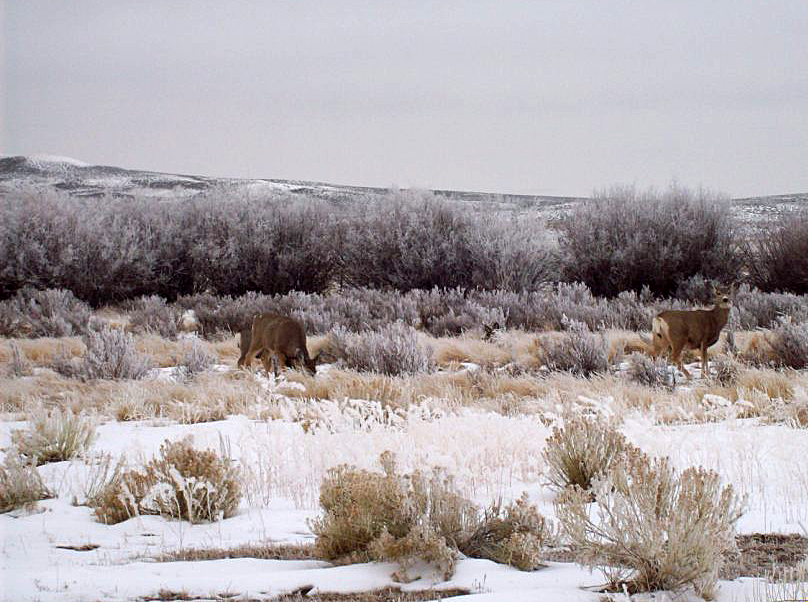
It’s not only cattle and ranch stock that we feed in the winter.  Plenty of deer, moose and sometimes elk also spend the winter on our ranch.  Some deer and moose will stay on our ranch year round, but in the winter time a lot more of their friends come down from the mountains to join them.  They are able to enjoy good winter grazing, warmth in the willows and some protection from predators.

Ranches provide an important habitat for all kinds of wildlife throughout the year.  By maintaining open spaces the deer, antelope, moose, geese, ducks, sage grouse (we call ’em sage chickens), etc. have a place to live.  If these ranches were to go out of business, as so many have, they would most likely become subdivided with houses built up and the deer, moose, etc. would no longer be able to stay or they may become some national park, in which case the wolves would move in and the deer, moose, etc would still be out of luck.  Either scenario paints a grim picture for the wildlife. Thank goodness for ranches!

Wyoming has 26 million acres of private agricultural lands that not only produce food and fiber and sustain rural communities, but also provide vital habitat for a myriad of wildlife species!

From RealRancher Kent Price – Daniel, Wyo.

Elizabeth’s Christmas Eve Gift

It’s so hard to find good children’s books that are based in agriculture, but a new story from a real ranch wife is just that! We’re featuring it on www.realranchers.com today as another way to share agriculture stories with you.

Elizabeth’s Christmas Eve Gift follows the youngster as she performs her everyday ranch chores and discovers the true meaning of Christmas. This is a great story to share with your ag and non-ag friends alike.

Author Chesna Smith is a real ranch wife from New Mexico who lives on a ranch with her husband, Joel.  This is her first children’s book and is based on the life of Joel’s grandmother when she was growing up on a ranch in the 1920’s.

www.perkycowgirl.com

Elizabeth’s Christmas Eve Gift

By Chesna L. Smith

A 32 page, full color, hardbound book

Written, Illustrated, Printed & Bound in the U.S.A.!!!

Available at www.perkycowgirl.com or by calling (719) 859-1731

Another Rancher’s Gamble – Bull Sales

Auctioneers, bulls, ranchers, food and often cold weather are all part of a bull sale. Each year ranchers have to buy new bulls (male cattle who have not been castrated) to put with their cows for breeding the next summer.  Bull sales usually take place in the months of October through March.

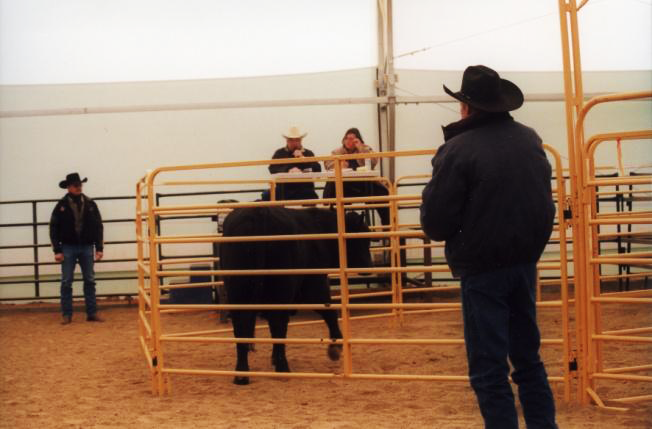
Sale-goers look at the bulls and information about the sales in the sale book. The cattle are available to look over before the auctioneer runs them through the sale pen.

Usually on the open range one bull is provided for every 25 cows to get a good calf crop. Sometimes extra bulls are put out with the cows to make sure a high conception rate happens and when the cows are pregnancy tested in the fall there is at least 90 percent of the cows bred.  A rancher can usually use a bull through the bull’s fifth year. Bulls need to be replaced when they are past their prime or if they get hurt and can no longer breed.

Looking at the bulls before the sale and visiting with neighbors and friends.

To buy the replacement bulls, most ranchers go to a bull sale at a purebred breeder’s place where the rancher likes the breeding and performance of the bulls.  The sale is an auction.  There is an auctioneer with ringmen to take the bids.  It is always exciting to go to a sale to see what they have to offer and see if you can afford to buy the bulls you like and want.

Bull buyers sit in the bleachers bidding on bulls to use for breeding female cows on their cattle ranches.

There are many things to look at when buying a bull. The conformation of the bull and also many of the genetic traits are important.  Conformation traits most people look for are: the muscle in the rear end of the bull, the length of the bull, the shape of the bull’s shoulders for calving ease, the depth of the bull’s body and the width of the bull. When cattle are grazed on the large grazing allotments with many acres the bull has to travel over, the condition of the bull’s feet and legs are very important.  The bull’s soundness has to be so a bull can travel the long distances and still breed the cows.

The different breeds have set up Expected Progeny Differences (EPDs) on the cattle.  Some of the EPDs to look at are the birth weight of the bull as a calf, the weaning and yearling weights and ratios, milk the cow would produce, and growth.  In the high altitudes of the Green River Valley PAP tests are used to see if the heart of the bull can handle the high altitude. That is a genetic trait that will be passed on to the offspring.  Cattle producers are always looking for improvements in how we breed our animals so other traits are starting to be looked at as well.

The ringmen, auctioneer and secretary work while a bull is being sold in the ring. The ringmen watch the crowd for bids (usually placed by a slight nod or lift of the hand) and alert the auctioneer. The auctioneer keeps the price moving with his constant chants sounding from the microphone. The secretary records all the winning bids and collects the money at the end of the sale.

Each rancher has his own idea of what traits best fits this cow herd.  The bull sale is just another part of the rancher’s gamble.  Ranchers gamble on the weather for water, heat to grow crops, snow depths, calving conditions, etc.  After eating a delicious meal served at the auction, the rancher buys his bulls for the next year’s calf crop.

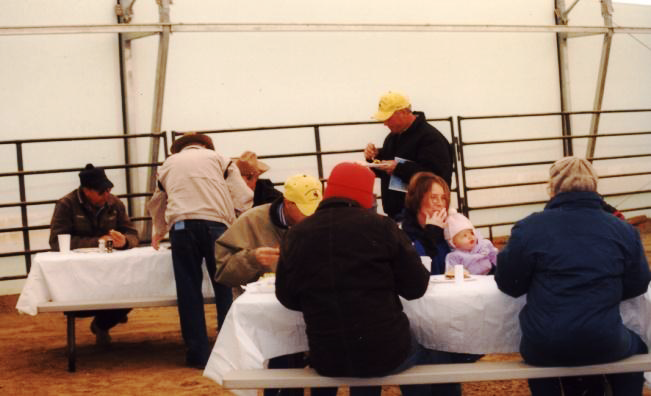
Eating lunch before the sale begins. At this and many sales, the local 4-H group will serve the meal as a fundraiser for their club.

From RealRancher Jonita Sommers –Pinedale, Wyo

Ranchers Brand New Elementary School

On July 20, 2010, the Green River Valley Cowbelles organized a branding for the new Pinedale Elementary School. Forty-five ranchers from the Pinedale, Daniel, Boulder and Cora areas were called. Thirty-five ranchers showed up with their brands and 73 brands were put over the entrance to the school and the entrances to the three pods. Kent Price brought a branding stove and did most of the branding. Cotton Bousman, Coke Landers and I also brought branding stoves. To learn more about brands and how to “read” them, click here.

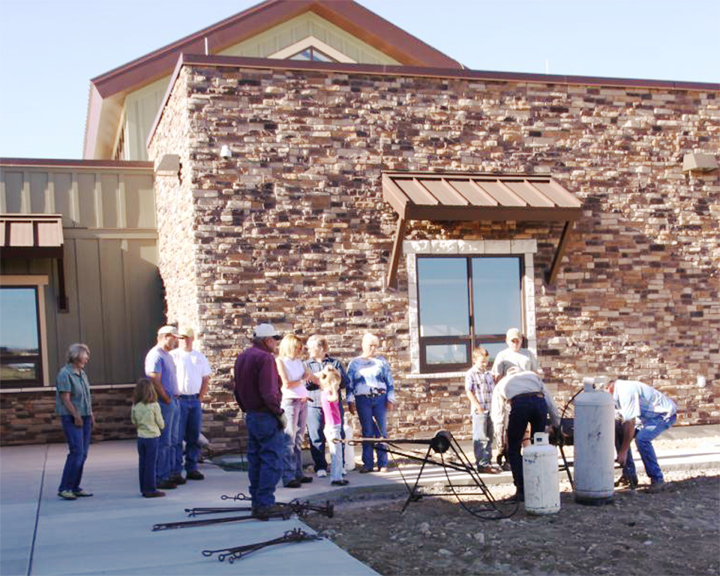
Green River Valley Ranchers setting up the branding stoves to heat the branding irons in the back of the new Pinedale Elementary School
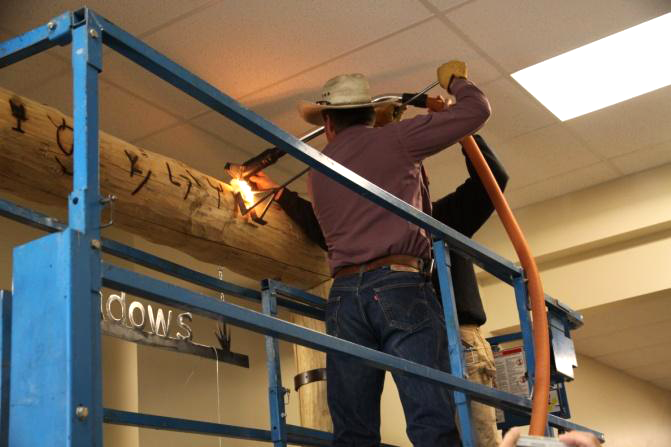
Kent Price putting on the brands while one of the construction workers vacuumed the smoke
Ranchers (Dave, Zach and Margaret Noble with Jonita Sommers watching and instructing Kent Price on how to place the brands
Placing a brand on the Plains and Meadow Pod

Brands on Doorways at Pinedale Elementary School 2010

Plains and Meadows Pod Entry  (Brands read left to right on log)

Rancher, Town                 Brand Name

1.  Mary Kay Jensen, Boulder        S 9 Bar

2.  Aaron and Diane Wilson, Pinedale      V O

3.  Scot Noble, Cora          S Lazy S

4.  Zack Noble, Cora          Bootjack

5.  Pape Ranches, Daniel          M E

6.  Messed up brand          A and P (not a brand)

7.  Max and Dianne Boroff, Daniel        Buckfence

8.  Mandy Frank, Cora          H Bar Lazy T

9.  Swede McAlister, Daniel        Backwards D M Quarter Circle

10.  MaryAnne Almquist & Annie Espenscheid, Pinedale  Y T Slash

11.  Jim and Jamie Jensen, Boulder        L 7 Slash

12.  Roberta Bacheller, Pinedale        Wagon Hitch

13.  Hailey Noble, Cora          H L Bar

14.  Aaron and Diane Wilson, Pinedale      Lightning Bolt

15.  Roberta Bacheller, Pinedale        Rafter E

16.  Sommers Ranch, Pinedale        Open A P

Mountains and Forests Pod Entry

Rancher, Town                                Brand Name

1.  Murdock Cattle Company, Pinedale      Two Bar E

2.  Jerry A. Jensen, Boulder          N A Bar

3.  Donald and Marilyn Jensen, Boulder      B F

4.  Roberta Bacheller, Pinedale        Arrow P

5.  Reese Noble, Cora          Lazy T Bar

6.  Chuck and Chris Bacheller, Pinedale      Falling Rock

7.  Gene and Betty Lou Pearson, Daniel      Down E Spear

8.  Lozier’s Box R Ranch, Cora        Box R

9.  Carroll David Noble, Cora        Quarter Circle F

10.  James and Andrea Rogers, Pinedale      Two T

11.  Carroll David Noble, Cora        L V

12.  Grindstone Cattle Company, Daniel      Lazy Y Y

13.  Charles and Dee Ann Price, Daniel      Bar 7

14.  Irv and Robin Lozier, Cora        Lazy Y Spear

15.  Brook Noble, Cora          Z O

16.  Doug and Lynda Vickrey, Daniel        E F

Rivers and Streams Pod Entry

Rancher, Town                  Brand Name

1.  Jamie Blaha, Boulder          W Bar

2.  Jensen Ranch, Boulder          Bar O 4

3.  Klaren Cattle Company, Pinedale      Steer Head

4.  Tom Noble, Cora          A K Bar

5.  Justin and Sandy Wright, Boulder      Fish Tail

6.  Donald and Marilyn Jensen, Boulder      6 X Quarter Circle

7.  Mike Vickrey, Daniel          Slash D

8.  Kent and Dawn Price, Daniel        Bar Diamond

9.  Bousman Livestock, Boulder        Seat Hook

10.  Chris and Carla Sullivan, Boulder      Bar C S

11.  Dr. Tom Johnston, Pinedale        J T Reverse J

Main Entrance

Rancher, Town                 Brand Name

1.  Blaha Ranch, Boulder          T 2 Bar

2.  Charles Price, Daniel          Open Box Lazy T

3.  Carrie Jorgensen, Pinedale        Quarter Circle V Bar

4.  Albert and Jonita Sommers, Pinedale      O 4

5.  Price Ranch, Daniel          H Reverse 7 Bar

6.  Sommers Ranch, Pinedale        Quarter Circle V

7.  Swede McAlister, Daniel        Pea Tree

8.  Klaren Cattle Company, Pinedale      V Lazy P

9.  Briggs Ranch LLC, Pinedale        O L

10. Kristen Klaren, Pinedale         Reverse K Reverse N

11. Susan Briggs, Pinedale          N J

12. Mark Jones, Boulder          M J

13. Laurel Bousman, Boulder        Spider

14. Palmer Klaren, Pinedale          Reverse K Lazy 3

15. Walter Bousman, Boulder        Bar V Z

16. Sandy Bousman, Boulder        J Lazy J

17. Nick and Lora Nichols, Boulder        Upside Down T Slash Upside Down T

18.  Jonita Sommers, Pinedale        Two Spear

19. Albert Sommers, Pinedale        Lazy M F

20. Norm Richie, Boulder          Sixty-Six Quarter Circle

21.  Jep Richie, Boulder          P Anchor

From RealRancher Jonita Sommers –Pinedale, Wyo.

Weaning, Shipping and Preg Checking

I know, I know. Sometimes it sounds like we ranchers are speaking a different language. But don’t fret! We’re about ready to explain what “weaning,” “shipping,” and “preg checking” are…

Weaning day is also shipping day for us. That means the calves that were sold last summer on a video sale and the females we keep (called replacement heifers), have been separated from their mothers and moved to another pasture. The steers (castrated males) have a new home in Nebraska, some of the heifers (females who haven’t given birth) in Montana, and the replacements are home in Lander for the winter.

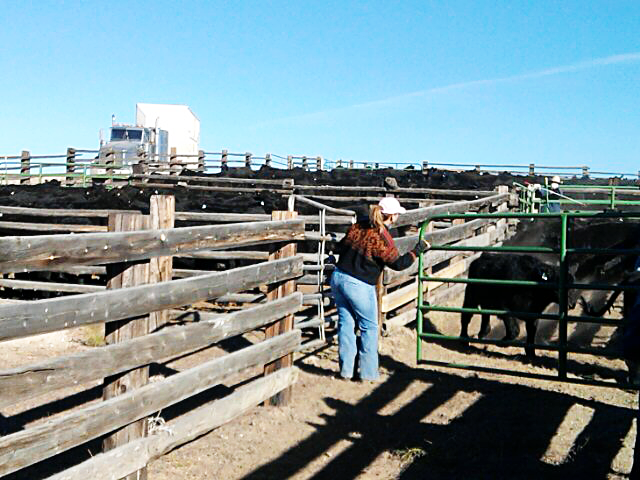
Timmery Hellyer works the gate during sorting and shipping time on their family ranch near Lander, Wyo.

Our steer calves are sold on a video sale. The video is a basic form of forward contracting. It is a really good way for a rancher to show and offer the animals for sale without having to physically move them to a place where they can be seen. A video sale is broadcast live on satellite TV and generally happens on the internet as well.

Shipping day begins with the neighbors arriving to help and everyone rides through the pasture to gather the cattle and start the weaning. Sometimes it gets a little noisy as the calves start hollering for their moms. Once inside the corral the cattle are sorted into groups of cows and groups of calves. The cows are then penned by themselves and the calves are then sorted into steers and heifers. This is called sexing.

After the sexing comes shipping. At shipping the steer and heifer calves that make the grade for size and shape, called the “sellers,” are loaded onto trucks and their journey to a new home begins. The replacements and everything else also get a ride to a new home.

The day after weaning we start pregnancy testing. Testing takes the neighbors’ help as well. Testing reveals whether the animal is bred (pregnant) or open (not pregnant). The entire herd is worked through a chute and sorted two ways when they exit the test. The bred cows are let back onto pasture and the culls (cows that are either bred late, are open, or are old) are moved to a place where then can’t mix back into the herd. Sometime later this fall or winter the culls will be sold to someone else.

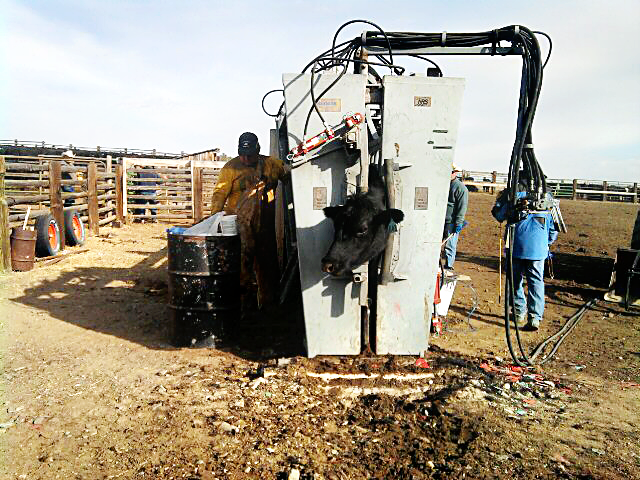
Cattle are worked through a hydraulic chute while the veterinarian checks whether they are bred or not. These livestock handling systems are efficient and safe for both the cattle and the operators.

With shipping and testing over at our place it is now our neighbors turn and we will soon begin returning the help to everyone who helps us. Just like at branding, if we didn’t have our neighbors, life would be a lot more work.

From RealRancher Jim Hellyer – Lander, Wyo.
The Farm Paparazzi

Armed with an automatic setting to expose a happy life full of God's grace

Facts About Beef

Debunking myths about beef

Beef Runner

Agriculture Advocacy, Beef and Running

Wyoming Lifestyle Magzine

a virtual visit to wyoming's rural communities

Wyoming Livestock Roundup

a virtual visit to wyoming's rural communities

Bridle-Bit LLC Blog

Horse & Rider Training. Serving The Northern Front Range Since 1981

Faces of Agriculture

a virtual visit to wyoming's rural communities

The 307 Chronicles

a virtual visit to wyoming's rural communities

Wyoming Roundup

a virtual visit to wyoming's rural communities

a virtual visit to wyoming's rural communities

Double H Photography

a virtual visit to wyoming's rural communities

Ladder Ranch

Scenes, thoughts and poetry from our working ranch

Comedy Of A Cowgirl

The Comedy of Storytelling

RealRanchers.com

a virtual visit to wyoming's rural communities