Cry Babies

Weaning cattle is a fun time on ranching operations. The calves you’ve worked so hard to raise are ready to go either to the feedlot or to market. It’s a rewarding time both mentally and financially.

For those of you with 35-year-old children still living at home, you’ll find the concept of weaning very useful.

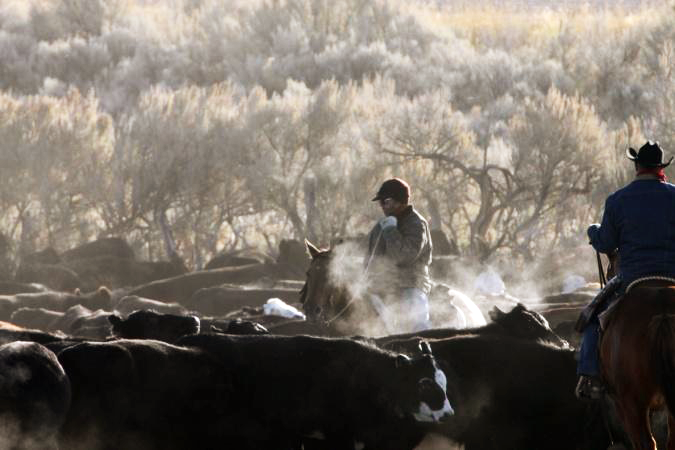
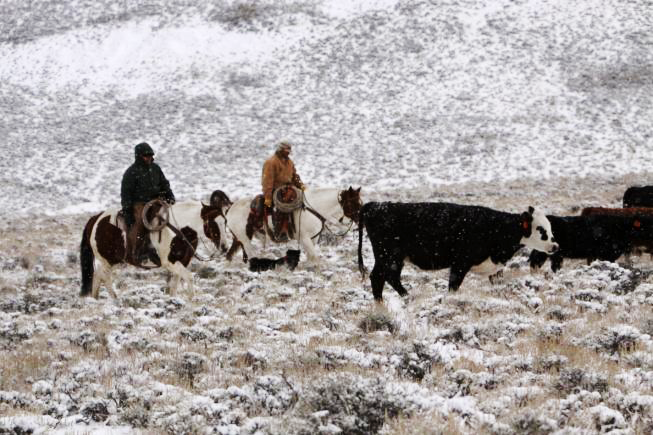
Monte Hamilton sorts his cattle and TRH Ranch cattle (female calves into one area, male calves into another and mamma cows in yet another area) at the Rocky Point Grazing Association, about 60 miles north of Moorcroft, Wyo.

“Weaning” in the livestock world is a very necessary part of the production process. When calves get big enough to fend for themselves they are separated from the mamma cows. Each ranch weans at different times according to what works best for their cattle. This is usually between 6-9 months. A lot of bawling and hollering ensues from the calves and cows. A sad sight to see (and a sad chorus to hear), but the crying must be endured because weaning is good and necessary for the cattle.

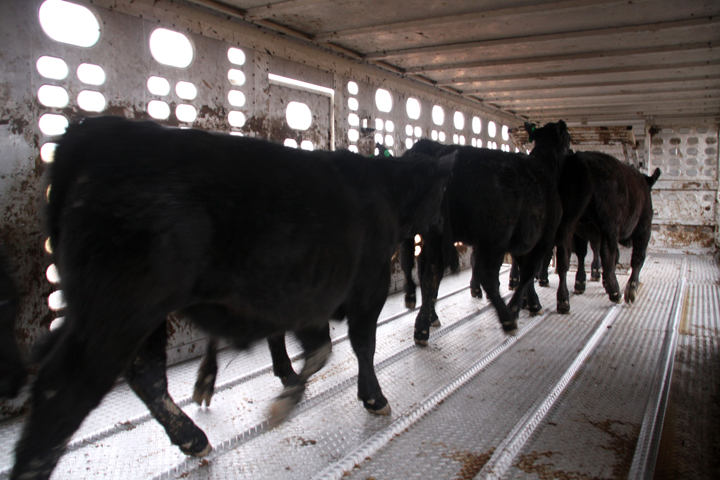
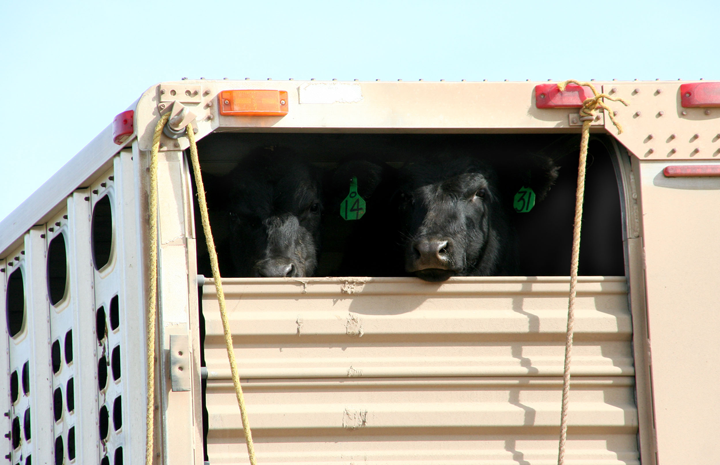
Tom Hamilton loads the calves onto trucks and they are hauled home to either north of Osage or north of Lance Creek. The mother cows are left behind for a few days before being shipped home. This gives the cattle time to adjust to the separation of weaning.

It’s important to wean calves to reduce stress on the mother cow. Weaning allows the cow’s body to transfer the nutrition that was used for milk production back to normal body functions. This improves her condition and gets her ready for the next calf.

The Hamilton's prefer sorting, then hauling calves to another location because the cows aren't bawling near the corrals the calves are in, and the calves seem to settle in faster.

If you’ve just GOT to know more about weaning, here’s a great in-depth article. If you have no idea what some of the terminology means…well, too bad. Naw, just kidding. We won’t leave you in the dark. You can ask questions in the comment section below or on the RealRanchers Facebook page.

Calves from the TRH Ranch, north of Lance Creek, Wyo. They are being hauled a short distance to the ranch headquarters after being weaned on the opposite side of the place.

From RealRancher Heather Hamilton – Lance Creek, WY

Encana & The Christmas Tree

In 2005, Encana Oil & Gas developed an innovative method of protecting wildlife habitat by decreasing surface disturbance and speeding the re-vegetation of disturbed sites.


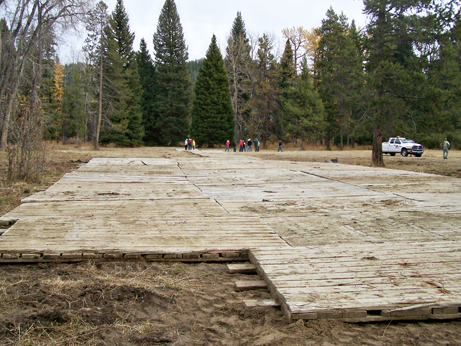
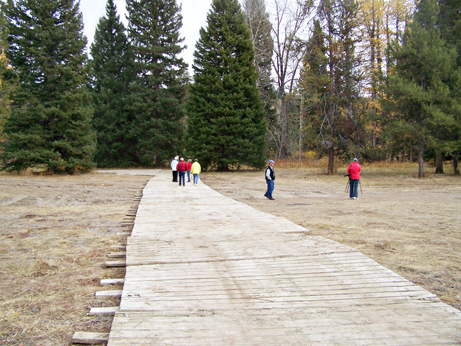
Encana’s project includes laying down 8 x 13-foot wooden oak mats on the surface instead of disturbing plants and soil by scraping roads and well pads.  Creating an artificial location by applying the wooden mats on well sites protects the root system of native vegetation that may otherwise be damaged.  As mats are laid down, they flatten the plants, but topsoil and root systems will remain intact and undamaged.  The mats protect vegetation, reduce damage to native plant root systems and limit soil compaction caused by equipment and vehicles.

Encana recently donated the use of this innovative environmental planking technology to the Forest Service for Wyoming’s US Capitol Christmas Tree in order to protect the area near Wyoming’s perfect 67-foot Engelmann Spruce in preparation for the cutting ceremony on November 6.

The Tree Cutting Ceremony will be held on November 6 with members of the Northern Arapaho tribe blessing the tree and a celebration on the Jackson Town Square later that afternoon.  Beginning November 10, the Tree will make a 20-day trek across Wyoming and the nation to Washington, DC with celebration stops in communities all along the way.

From RealPartner Randy Teeuwen, Encana Oil and Gas

ABOUT THE CAPITOL CHRISTMAS TREE PROJECT

The Bridger-Teton National Forest, at the request of Senator John Barrasso, is leading the State of Wyoming in the delivery of the Capitol Christmas Tree for 2010.  This is the first time in the nation’s history that Wyoming has been selected to provide the Capitol Christmas Tree.

The Capitol Christmas Tree will grace the west front lawn of the U.S. Capitol in December 2010.  The Architect of the U.S. Capitol has already selected a 67-foot Engelmann spruce from the Bridger-Teton National Forest that will be cut, loaded, covered and prepped for travel in November to Washington, D.C.

In mid-November, the tree will be toured across the state of Wyoming before heading east to the U.S. Capitol.  In late November, the tree will be delivered to the U.S. Capitol, where it will be lowered into 5-foot deep hole, strung with lights, and decorated with thousands of handcrafted ornaments made by Wyomingites from across the State.  In December, the Speaker of the House, along with one Wyoming student, will light the tree and showcase Wyoming’s historical, cultural and natural beauty.

Through the holiday season, the tree will be lit at dusk, where it will be enjoyed by people from across world.  The theme of Wyoming’s tree is “Wyoming- Forever West.”

For more information on the Capitol Christmas Tree for 2010, please visit: www.capitolchristmastree2010.org.

Follow the Capitol Christmas Tree on:

Twitter at: www.twitter.com/BridgerTetonNF

And Facebook at: http://www.facebook.com/home.php?#!/pages/Capitol-Christmas-Tree-2010/104904166232147

Winter Grub from Summer Toil

As fall races ahead, closing the gap on winter, did you ever wonder how we ranchers feed our livestock during the snowy months? The pastures offer only a limited amount of forage during this time, so we supplement with hay, among other things.

I live in Boulder, Wyo. where we only harvest our hay once a year unlike other places where it is warmer and ranchers raise alfalfa hay which can be harvested up to four times a year (four cuttings). We harvest native hay which is native grasses that grow there naturally.

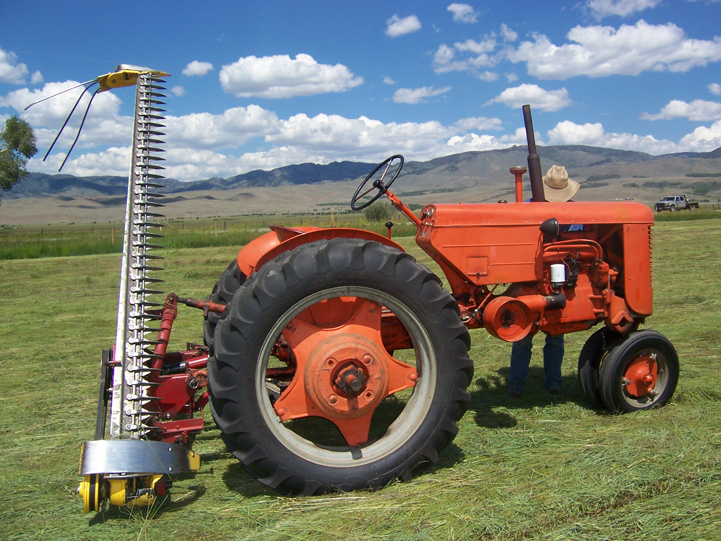
Our haying tractor with the sickle bar mower folded up.

We first mow (cut) the hay with either a 7- or 9-foot sickle bar mower. Then after the hay has dried out (cured) we rake it into wind rows for the round baler to pick up and make a bale.

The sickle bar just as it begins to cut the hay.

Round bales average weight: 1300 lbs. – 1500 lbs. (1 ton =2,000 lbs)

Bales are stacked together in a fenced stack yard for storage for winter feeding. Some hay is put up loose into large piles.

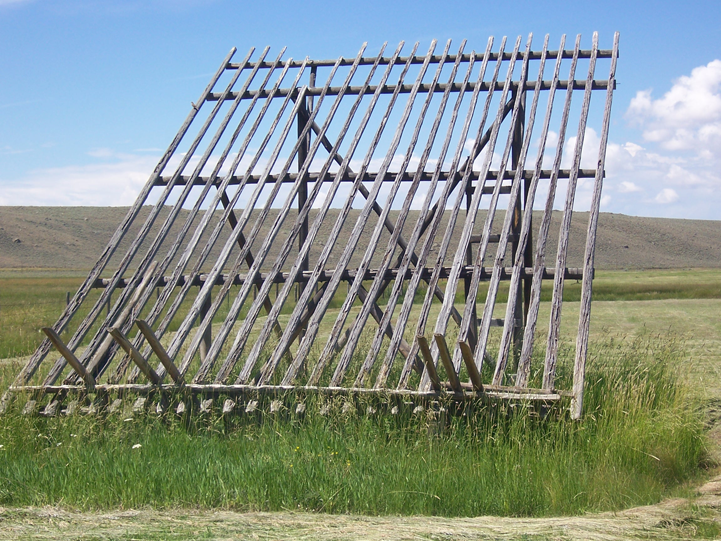
This contraption is called a "beaver slide." It is used to stack loose hay.

Stack yard fences are 12ft high to make a wild-game-proof fence. We have to keep wild game out (moose, elk, deer, etc.) so they don’t eat or destroy the bales of winter feed. The Wyoming Game and Fish provide feed grounds for the elk and other wild game to help keep them away from the ranchers feed.

From RealRancher Kari Bousman – Boulder, Wyo.

A Family Affair

The typical Wyoming ranch is a family affair. It’s survival depends on all family members uniting for the common cause of making a living off the land. Preceding generations pass to their descendants the love and respect for the land and the care of the animals stocked on that land to harvest the grass.

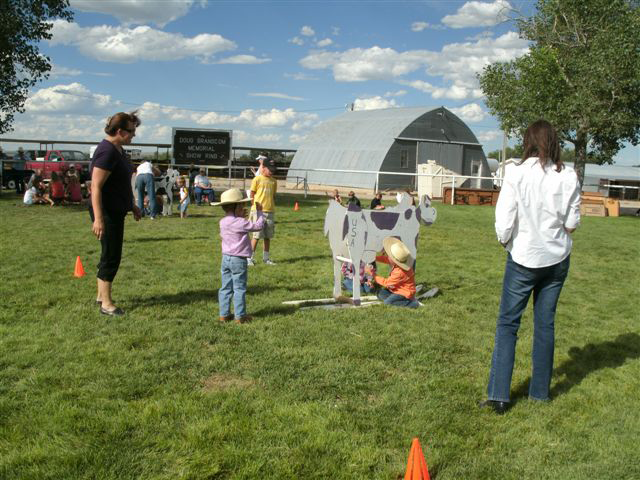
Youngsters at the Platte County Fair in Wyoming practice "milking" a cow. County Fairs are great places to learn and show off skills related to agriculture.

Intermingled with the hard work, families also find the time to play together. The highlight of the year is the local county fair where 4-H and FFA members show the results of their annual labors. This usually takes place in July and early August.

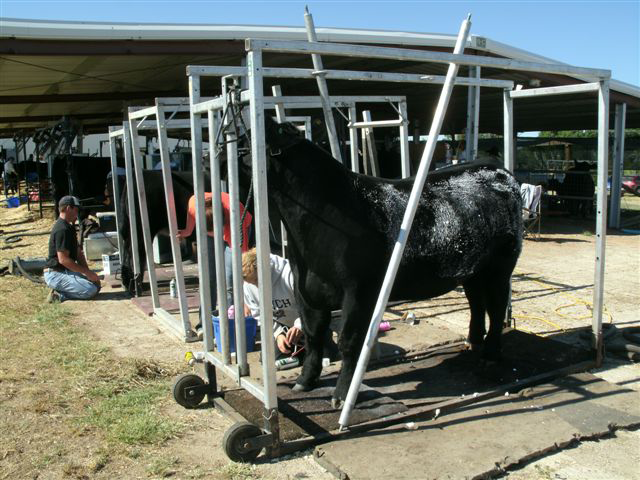
Cattle are washed, their hair trimmed, blown dry and brushed (called "fitting" in the show world) in order to put on best appearances for judges at the local County Fair.

Activities for kids as young as 3-years-old are planned as a precursor to the big show ring.

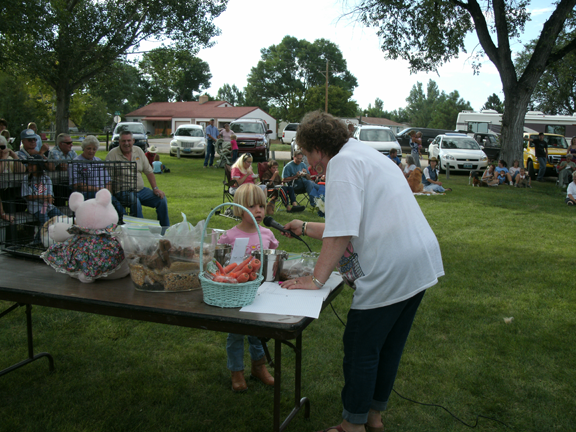
This little Platte County tyke answers questions regarding agriculture products at the County Fair.

Motherless bottle calves are shown by their little caretakers who have had the responsibility of feeding them twice daily. If a child doesn’t have access to a big critter, the Pet Show allows him a place to participate. PeeWee Rodeos mimic some of the events of the real thing from the backs of snortin’ stick horses. At the sidelines, the entire family is cheering for the youngest members instilling in them a sense of value and worth that remains with them to adulthood.

"Bottle calves" are calves that were orphaned or refused by their mothers, leaving it up to the ranchers to feed (often with a bottle) and care for. Youngsters can bring these bottle calves to the local county fair to show.

A ranch is a wonderful place to grow up!

From RealRancher Donita Graves, Wheatland, Wyo.

REAL Housewives

Many of you are probably aware of the “Real Housewives” reality TV shows. These show depict spoiled, out-of-touch women across the nation and they call it entertainment. Well, a great post on Fox News by Patrick Dorinson,  The Cowboy Libertarian, has a very interesting take on who American women should look to as good examples. Here is an excerpt from his post:

Recently I was in Idaho visiting with my good friends who are cowboys and ranchers. This time of year is for gathering their herds of cattle off the range in preparation for the hard winter that is to come.Work on the ranch is a family affair and everybody works—men, women and children.

But no disrespect or offense to the men, the hardest-working folks are the women. I call them the “Real Housewives of Idaho.” Their names are Jenn, Jayme, Kassy, D.J. and Janis.

I knew these women before I even met them, since I was raised by someone just like them.

They don’t have their own TV show although it would be a helluva lot more interesting than watching the other “real” housewives and definitely better than watching Maher’s weekly ego fest.

They don’t wildly spend money on frivolous things at high-tone stores. They shop at Costco to feed the family and during gathering feed the crew. They are partners with their husbands. Their children are taught the lessons of work, faith and family from the time they can walk and as soon as they can walk they are in the saddle working right alongside their parents.

You don’t hear a lot of whining about how tough their lives are. They know life is tough but they wouldn’t have it any other way.

They don’t have weekends. Saturday and Sunday are just two more days to get the work done.

They don’t stab their female friends in the back when they aren’t around. They pitch-in to help each other and treat each other’s children as if they were their own.

They don’t hang out at Starbucks because they aren’t dumb enough to pay $5 for a cup of coffee and don’t have the time or the inclination to sit around and be neurotic and catty.

And they face adversity everyday and meet it head-on.

Last year we hadn’t been out gathering cows more than an hour when someone spotted a bull used for breeding stuck in mud wallow. It had died struggling to get out. I was riding with my friend Jenn whose bull it was.

As we sat there on our horses she calmly said, “Well, there goes $5,000.” When the young cowboy who had found it asked, “Should we pull it out?,” she said, “Nope. No time. We’ll come back later to see what happened. We’ve got to keep going and gather the rest.”

No crying. No whining. No pointing fingers of blame. It happened and the only thing to do was keep going. And that pretty well sums up their lives—keep going.

Click here to read the entire article. Thank you to Patrick for his great perspective on ranching women. Let’s follow his lead and continue to tell the story of real, hardworking American ranchers and farmers.

From RealPartner Liz LeSatz, Wyoming Stock Growers Association

Coming Home for Winter

As the temperature cools, the leaves turn to brilliant yellow and orange colors, the days shorten and eventually snow appears on the mountain summer range, the cattle head for home. The cows are just like the deer and antelope. They start migrating to the home ranch as the fall weather start to send reminders of winter.

Many of the cattle run in common grazing allotments where several ranchers’ cattle run together (see Kent Price’s posts on the driving cattle to the summer pastures).  As the cattle trail from the mountains and reach the low lands, the ranchers have to separate their own cattle from the main bunch and take them to the home ranch.

Rancher Nikki Marincic watches the Price-Sommers cattle during fall gather near Pinedale, Wyo.

Depending on the location of the home ranch, the cattle trail five to 70 miles to get to a “cut ground.”  A cut ground consists of an open area, vaguely defined either by fences, roads, or topographic features where cowboys separate the cattle according to which ranch’s herd they belong.  The cattle are bunched in a localized area and each rancher rides into the herd and “cuts” or brings out his own cattle from the main herd.  The cattle are put in a “cut” or herd consisting only of the individual rancher’s cattle.  The rancher’s cattle are identified by the rancher’s brand and earmark (tag or notch on the cattle’s ear, much like an earring) that is on each cow.

As Kent Price talks about in his posts on http://www.realranchers.com, the cattle bunch up at the "Drift Fence." Here the livestock can be easily "cut" or separated based on which ranch owns which cattle.

Many of the cows know where their cut is located and they try to get there on their own accord.  If they have their calf with them, the ranchers will usually allow them to go on their own.  Many times the cow has become separated from her calf, and has to be “mothered up” or joined with her calf before she is allowed to leave the herd.  Yearlings are like many kids and are just having fun.  They don’t care where they are while enjoying life.

The wintery weather in Pinedale comes earlier than in other parts of Wyoming. Here the ranchers are driving cattle home after spending summer on the range.

While the rancher is in the main herd cutting out the ranch’s cattle, other riders are on the outside keeping the main herd in one bunch and only letting out the cattle being driven to the individual cuts.   There will be another rider by each individual cut to keep the cattle in their designated area and not allowing stray cattle into the “cut.”

After driving the cattle down off summer range, they group up at the Drift Fence to be cut into each ranch's herds.

Once the cattle are all separated, they are driven to their home ranch.  This process goes on for around two weeks as the cows trail from the mountain pastures.  The summer cowboys ride back for the cattle in the mountains which have not headed home.  After it has snowed enough to make the landscape white, an airplane is often flown over the range to look for stragglers which are still in the mountains.

Often the riders go back several times to get the stragglers who haven't come down on their own accord.

As the sun rises over the Wind River Mountains and the steam from the breath or hot bodies of the cattle can be seen in the air, the excitement of working the cattle takes place.  It is a great feeling to have a well trained cow horse move its muscles under you as the horse automatically outmaneuvers and out thinks the cow to put her on the edge of the main herd and then into the individual cut.  This is also a great time to visit with neighbors and friends.

Cattle get loaded into trailers to haul to the home place.

Some ranchers have private allotments in the foothills and haul or drive their cattle to and from the private pasture, but we’ll save that for another story.

By RealRancher Jonita Sommers –Pinedale, Wyo.

Are you ready for some ranchers?

…We are too! And we’re on track to getting the blog back up again! Thanks for all you loyal followers who are practicing patience (are we done practicing yet? should be pros by now…) while this tech-a-phob tries to figure out how to bring you the awesome ranching messages from our RealRanchers!

Together in agriculture,
Liz, Wyoming Stock Growers Association
Super Cow

We had a purebred angus cow that wasn’t holding still long enough for her calf to eat.  Confining her in the corral gave her calf a chance to finally get his dinner. By the next day the old gal felt like she had things in hand and was determined to leave as soon as possible.

Her exit strategy? She made a high jump right over the corral fence, a six foot pole vault, previously unscaled.

Though she came through without a scratch she did manage to break the top most pole on her way out.  I tried to get her to go back the way she’d come but she would have none of that so I put her into another area that I felt would keep her corralled.

She immediately jumped that fence too without any damage at all to the poles. However, she left her calf behind and while I worked to get him to the gate, she decided  to come right back in, knocking down another pole in her unsuccessful attempt to get to her calf.

When I was finally able to get the pair into a nearby pasture I knew that “Super Cow” was a most suitable name for this belligerent bovine, a moniker to be forever remembered in the Price Ranch annals.

From RealRancher DeeAnn Price – Daniel, Wyo.

Gardening…Sublette County, Wyo. Style

I hear it all the time.

“You can’t grow a garden here.”

“It’s too cold!”

(An elevation of 7,192 feet doesn’t help much either).

There is no doubt that we can have frost here any day of the year.  We usually can’t plant until the first of June and sometimes even later than that. Tomatoes, corn and winter squash aren’t going to make it but all of the root vegetables do fine, and I grow lettuce, peas, beans and snow peas as well.  It helps to buy quick maturing seeds from a seed catalog. Cabbage usually does well and most of the time I have broccoli and cauliflower too.  A pretty good spread, especially when what grows most is sagebrush.

I laugh though when I tell people that sometimes I cover my plants more than I uncover them.  My old blankets are usually in use through August and September.

When our son, Kent, and wife, Dawn, moved here three years ago, Kent came up with an innovative idea (innovation on the ranch is all but a necessity). He gathered up the leaky and discarded cattle watering tanks around the place, filled them partway with gravel and then the rest of the way with manure and topsoil, (our sagebrush soil requires a lot of organic material).  After mixing the soil and manure together with a shovel he planted his seeds and I was surprised to see how well his plants did compared to mine.  Last year he found a couple of tanks for me also and I planted my beans and snow peas in those.
I actually got a few extra beans and peas to put in the freezer.

From RealRancher DeeAnn B. Price – Daniel, Wyo.

Pictures by Kent C. Price

Cow Spa

Welcome to the Hamilton Cow Salon and Spa where we specialize in all the finest comforts for the bovine species! Located north of Keeline, Wyo., we work day and night to make sure our customers find their pasture stay delightful.

Today I’ll show you the new wave of skin…er…hide treatments for all you cows who want to look refreshed and rejuvenated (and fly free)! It all starts with a back rubber, a cowboy, a pickup truck and our top-of-the-line treatment.

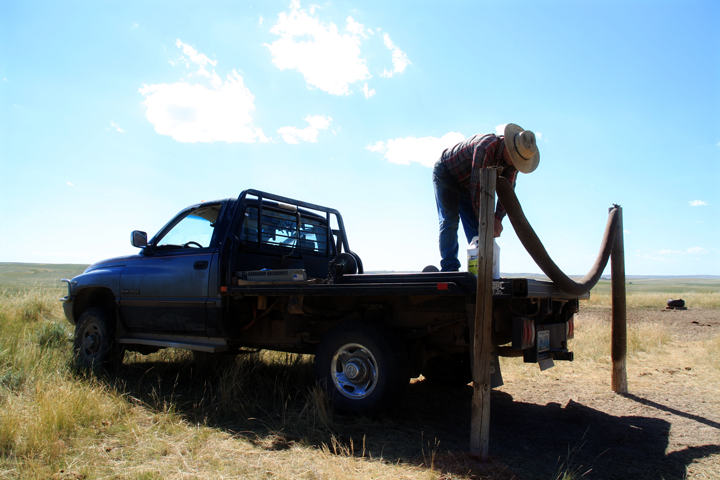
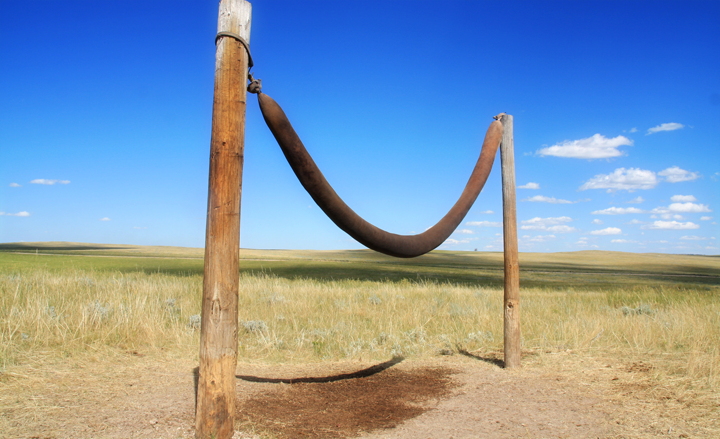
The back rubber is all the rage among the cattle herds these days. This particular treatment station is located in a yearling steer (one-year old castrated male) pasture. Made of a permeable cotton cover and a soft stuffing of rags, the back rubber absorbs a mixture of permectrin (concentrated fly spray) and diesel fuel (helps the concoction stay on the hide through any weather conditions and helps it soak in).

Now to achieve the subtle glow all the cattle are going for, you first have to soak the back rubber with the mixture (kind of like a hot-towel treatment, only…not). One of our spa’s pickups will do the trick to get a really good angle on the job.

Now we only use a truly wonderful smelling mixture for our treatment. The diesel really gets you in that relaxed, spa-like state.

Our master salon-technician, Tom, is a pro when it comes to really getting the back rubber good and soaked. Many a bovine will be singing his praises as the cotton tube massages their back and infuses the natural oils into their hide. They’ll be gorgeous and fly free for weeks to come!

The jug isn’t really Rotella oil, I promise. We just have always implemented a recycling program at our establishment. Reuse, reduce, recycle! We were “green” before green was cool.

Great job Tom! The cattle will be lining up for miles just to take part in this tried-and-true hide treatment. They’ll walk under the cotton tube and the stresses of life in the fast lane will melt away as the treatment soaks into their hides. The benefits of this spa treatment will go beyond the initial comfort of the treatment. They be rid of the flies that bite and pester all day long. I can hear their sighs of relief and relaxation already.

All in a day’s work at the Hamilton Salon and Spa!

From RealRancher Heather Hamilton – Lusk, Wyo.

Check out more of Heather’s adventures at her own blog http://doublehphoto.blogspot.com/.

The Farm Paparazzi

Armed with an automatic setting to expose a happy life full of God's grace

Facts About Beef

Debunking myths about beef

Beef Runner

Agriculture Advocacy, Beef and Running

Wyoming Lifestyle Magzine

a virtual visit to wyoming's rural communities

Wyoming Livestock Roundup

a virtual visit to wyoming's rural communities

Bridle-Bit LLC Blog

Horse & Rider Training. Serving The Northern Front Range Since 1981

Faces of Agriculture

a virtual visit to wyoming's rural communities

The 307 Chronicles

a virtual visit to wyoming's rural communities

Wyoming Roundup

a virtual visit to wyoming's rural communities

a virtual visit to wyoming's rural communities

Double H Photography

a virtual visit to wyoming's rural communities

Ladder Ranch

Scenes, thoughts and poetry from our working ranch

Comedy Of A Cowgirl

The Comedy of Storytelling

RealRanchers.com

a virtual visit to wyoming's rural communities