Josiah’s Recovery

Rangeland Intern Josiah Masie has been absent from his mentoring ranch in Lander due to an unfortunate break in his leg. He was home for roughly two weeks but it back on the ranch hobbling around in a walking boot. Here is what he had to say about his first few days back:

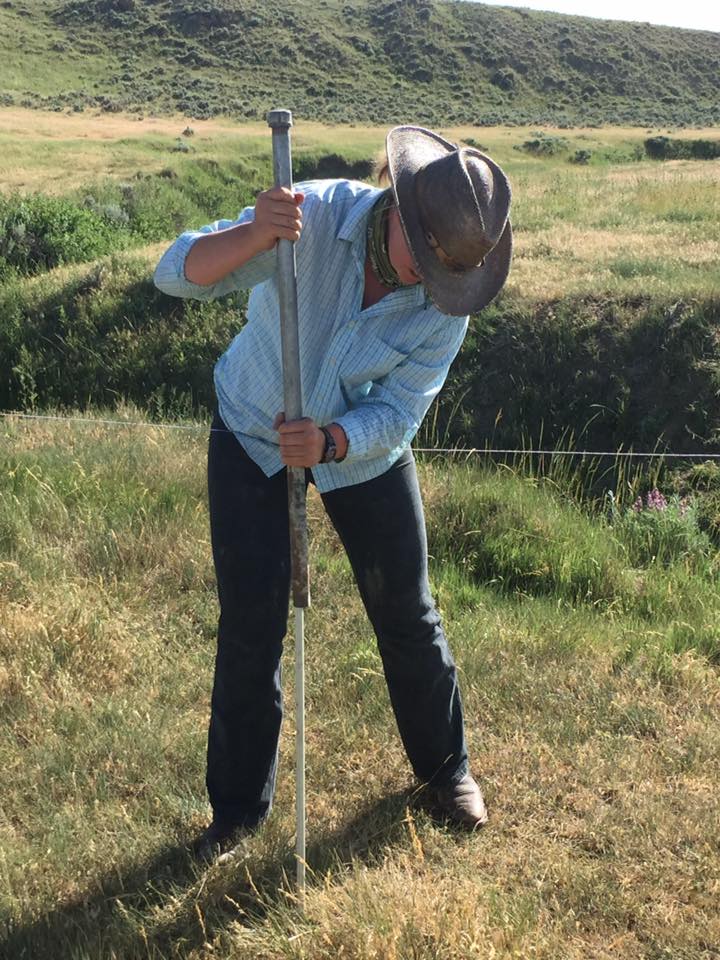
I’m back! After a couple weeks of recovery I’m finally able to gimp around the ranch again. I made it back Wednesday (the 20th)  and promptly started up again, mowing my lawn, getting some weeds knocked out, and general cosmetic work. The following days I have been fencing, trying to get the dairy pasture all fenced in again (it was damaged during the flooding and we just haven’t had time to put it back together). That’s been nice to do, since its close to the house and I don’t have to do much walking. Its actually the first big fencing project I’ve been trusted to do myself, so that’s pretty cool. I have to sink about 5 posts, notch them cut poles to fit, put up the poles up, and then make an H brace to tie into the barb wire fence. Its been slow going but by the time I’m done with it I should just be getting out of my boot and be able to wear two shoes just like a real boy.


Chasing Cows

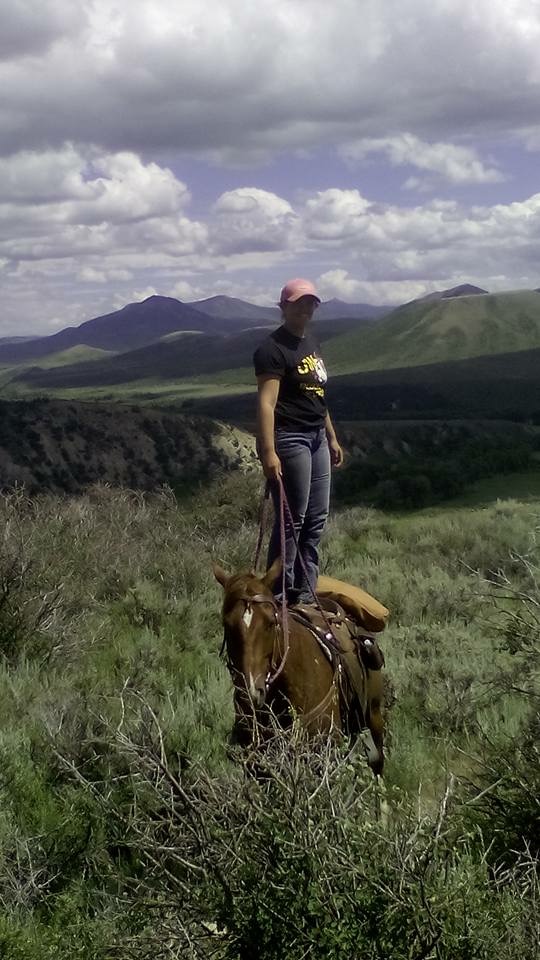
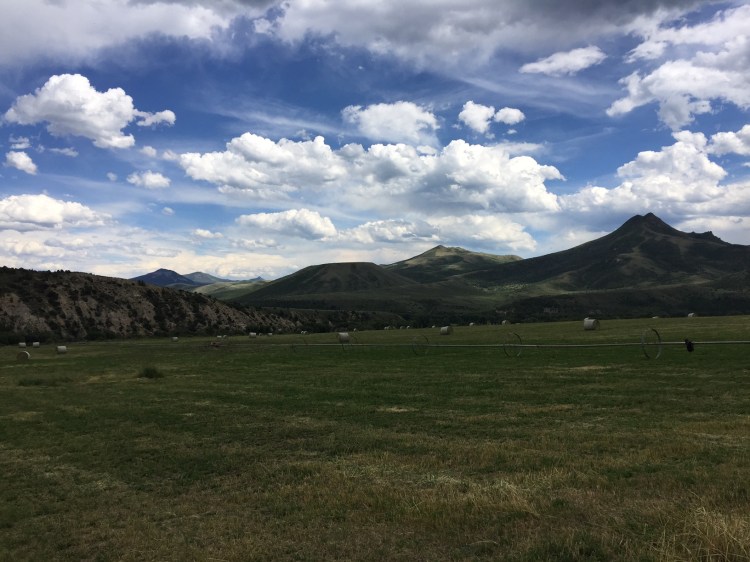
Samantha had an eventful week per usual at Ladder Ranch. She touches on fixing fence as well as chasing cows all over the property. Oh the joys of moving cows! Here is what she had to say about her experience last week: week 8 standing on horseweek 8 scenery

To start the week off, the other ranch hand and i spent quite a bit of time working on a fence around the pasture that they call “buck camp”. It was important for us to fix this part of the fence since we’ll be putting the cows left on the ranch in this pasture next week. A large majority of the fence was fixed on the neighbors’ portion but once we hit the part of the fence that was on ours, we had to spend a lot more time fixing the fence!

We spent another day this week gathering and moving the bred heifers out of their pasture and moving them across the ranch to where they will spend the majority of the rest of the summer! We ended up being 6 animals short once we got back to the corrals at the house with the heifers, bulls and dry cows. After sorting out the dry, we moved the heifers up the road. The next day, I went with Chad (another hand) to go back-ride to look for the missing 6 cows! We were missing 5 heifers and 1 bull! After riding for over 6 hours, we started to head back to the house to go eat lunch. Right as we were about to head into the alfalfa field, we looked over to find the missing 6!!! This was more funny than anything in my opinion! After getting them into the pasture that we were in, all 6 cows split off and ran into the tall brush. The small herd split in half, with 3 of the heifers missing, we ended up chasing them all over the place and eventually got the first half to the barn. After lunch, we went back for the last 3. This was just as bad. We lost them in the tall brush and I ended up standing up on my saddle in an attempt to find them!! (Pictured above) We eventually got them to the house!!

The rest of the week we spent moving alfalfa bales to the sheds in Dixon, WY. These bales will be used in the winter to feed the sheep and cows!

Learning, Teaching and Hard Work

Rangeland Intern Allison Harvey is busy at work in Gillette. She had a bit of trouble with fence this week, this is what she had to say about it:

“On Tuesday it seemed that every animal that could get through a fence did get through a fence.  The heifers, steers, bulls, and rams all managed to get through on the same day.  After we did the routine ranch check, we attempted to roughly sort the steers and the heifers away from each other.  When it cooled off a bit, we brought the sheep up to separate off the rams from the ewes and wethers.  We also separated off twenty wethers for processing.  Luckily, the pen the bulls got into was empty.

On Wednesday, I performed the routine ranch check.  I fixed the gate that the rams had broken through and checked on the sheep.  I repaired the temporary fence near the heifer waterer where they knocked it down.  I also repaired the temporary fence where the steers had knocked it down.”

This was a great learning experience for Allison as these are definitely the day-to-day happenings on a working operation!

She was also given a great opportunity to teach this week!

“We also had a group of 4-Hers out for a day camp.  We started the day off by collecting sticks and stones for an art project and making homemade lemonade.  Before lunch, we necropsied a lamb that had been recently wounded by coyotes and explained the challenges of protecting the livestock while teaching about anatomy.  After lunch, we followed up on how we protect the livestock by introducing the guard dog puppies.  While they worked on their craft, I showed them my snake and talked about snakes.  We finished off the day with homemade ice cream and showing them dried animal bones.  While some of the kids came from ranch backgrounds, most of them did not.  It was fun to answer questions about ranching and to see their fascination with it.  One question I got a lot was why we keep the livestock out on the range if they can get eaten by wild animals?  I explained that because this area doesn’t get a lot of rain, and because the country is so rough, it’s hard to harvest enough forage to keep the animals in a barn.”

Keep up the great work Allison!

Getting Comfortable in the Saddle

Rangeland intern Ian Zerbe is still hard at work with the Allen family in Lander. He has moved up the mountain to the upper ranch to work primarily as a wrangler, and going on pack trips. Some of the other wrangles that Ian works with love to take pictures, and he is then able to share them with us. It is so fun to visually see what he is up to each week. Here is a little bit of what he had to say about last week and transitioning into the second half of his summer on the ranch:

Learning the horses has been challenging because there are so many of them but as I spend more and more time with them I have started to realize each one of their unique personalities. There are roughly 65 horses at the upper ranch now that we have been cycling through pack trips and day rides with the guests. So many of the horses look virtually identical but for a few minute markings. I am constantly amazed when Jim, Mary, and Jessie Allen can look from a couple hundred yards away and rattle off all the names of the horses as they mill around. However, I am noticing a great deal of improvement in my horsemanship skills as well. Working with these horses every day you start to get a feel for each ones unique personality and where each fits in to the herd.

I have also far surpassed my previous records for hours in the saddle. Just the other day another wrangler and I packed in on a 26 mile round trip in to the mountains to take supplies to the forest service. The men we supplied were in charge of clearing all the trails in that area of trees and boulders so they would be accessible. After 14 hours of riding and clearing a few trees of our own, we were very glad to get back to camp for a hot meal and warm bed.

This past week I have been in some of the coolest places and seen some of the most amazing scenery I have ever seen in my life, I can’t wait to see what next week has in store!

Transition Time at Ladder Ranch for Samantha

Rangeland Intern Samantha has been hard at work, with early mornings and busy days. She was able to go into the town of Dixon one night for the local rodeo where the ranch donates Ewes to be used for Mutton Busting. Sounds like a good night off work! 

Samantha also explained that all of the cows and sheep have been moved to where they will spend the rest of the summer. This was a transition week for the main ranch and she is now working on other tasks! Here is a little bit of what she had to say about her week: 

“One day this week we spent a morning and part of an afternoon moving some cows from one pasture to another. This herd is the one herd that is left on the ranch as of right now! On our way to go move these cows, we made the attempt to move another bull from the corrals at the house up to there. We made it about 1/3 of the way before the bull got away from us! We decided to leave the bull where we lost him so we could load him up on a trailer instead of trying to fuss with his poor temperament. On the way back, we moved a small herd of bucks (male sheep) and 2 cow/calf pairs back to the house. After we got to the house, a small group of us trailed the bucks across the river to where the rest of the bucks are at. It was really difficult to get the bucks to go into the river and across it! Eventually we decided to rope the horns one of them and pull him across as a leader! This was definitely our best option.

When we moved the cows up onto the forest, we somehow left 30 cow/calf pairs in the first pasture. On Thursday, two of us packed salt blocks up to some of the cows and spent about 8 hours looking for the missing 30! We never ended up finding them that day but will definitely need to spend some more time up there to make sure that we find them!”

Allison Gets to Have Some Fun

Allison has had a fun filled week with an International 4-H Exchange student from Korea. What a fun experience! She has also learned more about the breeding process not only in cows but pigs too! See what she had to say about her week on the ranch:

Early this week we tested the bulls.  They’ll start breeding in about three weeks.

We brought up the heifers from the winter grounds and prepared them for breeding.  We gave them wormer and mineral and then trailed them out to their pasture for breeding within the next few weeks.  When we checked on them the next day, we discovered that they had escaped through a gate bordering the neighbor’s land.  We had to scout out where they had went, separate them from the neighbor’s cows, and separate out the dry cows that had managed to get into the herd as well.  It was quite the process.

We have an International 4-H Youth Exchange student from Korea staying with us for a week, so we had a week full of touristy things.  We went to Devils Tower, the Buffalo Jump, and a fish hatchery.  We also took a tour of a coal mine.

Pigs were my main focus in 4-H, and we ordered semen for many of our sows and gilts.  It was super interesting to see the semen collected because I had no idea how the process was performed.  I learned that you can do it with an electric probe, mechanically, or with an artificial female.  I was able to view the semen under a microscope for motility and morphology.

Hard Work Pays Off for Josiah

Josiah sure seems to be getting good at irrigating! Not to mention, he had a special visit this week! Check out what he had to say about his time on the ranch last week:

It was a fruitful week of irrigating. The grass has finally started to grow and in another week or so we will have some decent hay to cut. Its nice to see that all the hard work I put into irrigating is finally starting to pay off. On top of irrigating I started fixing fence in and around the canyon. I’m starting with a massive fence that runs from one end of the canyon to the other… It will probably take me a week or two finish, but so far it isn’t in too bad of shape, which is a plus.

This weekend my sister came to visit. It has been a blast seeing her… she’s staying through the 4th, so hopefully that will be a good time as well. Thursday night I tweaked my right leg, its been consistently bothering me so I might have to go in and get it checked out at some point. Other than all that its been a pretty relaxed week. We’ve been having afternoon thunderstorms all week which has been a great change from the 100⁰ weather I’m normally used to. Hope you all had a great Forth!

Ian is Always Learning

Each week Ian Zerbe seems excited to be learning numerous tricks of the trade. Last week he attended the Environmental Stewardship Tour in Sheridan County and was interested to learn how other ranches, such as the Kane family, operate their ranch. He also showed off his moves on the dance floor! Check out his update from last week on the ranch: 

Haying, packing, and hauling! We have been hard at work hauling certified hay up the mountain to use throughout the rest of the summer and hunting season. I have been working on machinery and putting it to use cutting raking and baling hay. As the summer progresses, I am getting increasingly better and more efficient at packing and working with horses. Up until I started working with the Allens, I had only worked with and rode a hand full of horses and now I’m sure I’ve doubled that. Not to mention packing and unpacking at least 20 more.

Irrigation continues to amaze me as I see how much everyone around here relies on it. Keeping the growing fields wet and the hay fields dry until we are done with them is a constant chore. At the Ray Canal Water Users meetings it is clear that we aren’t the only ones worried about the water and how much there is going to be for how long. However, the highlight of this week was definitely the Stewardship tour. It was amazing to see the work that the Kane’s had done improving their ranch for the last several years and seeing what it has become. I think that as a rancher or farmer we become so in tune with our own operation that it makes us somewhat single minded. I think the Stewardship Tour is an awesome opportunity to take a moment to learn from another’s successes and/or failures and realize what resources are available to deal with our own unique set of problems. I definitely hope I get the chance to attend another one of these events in the future.

Counting Sheep

Rangeland Intern Samantha McIntosh has been busy at work with all sorts of different animals on the ranch, but the last few weeks have been focused around the Ewes and Lambs. She got to have a mini “vacation” and travel to Sheridan County for the Environmental Stewardship Tour last week. Here is her update: 

What a week here at Ladder Ranch! With the end of June approaching us, there are a lot of things going on around here!

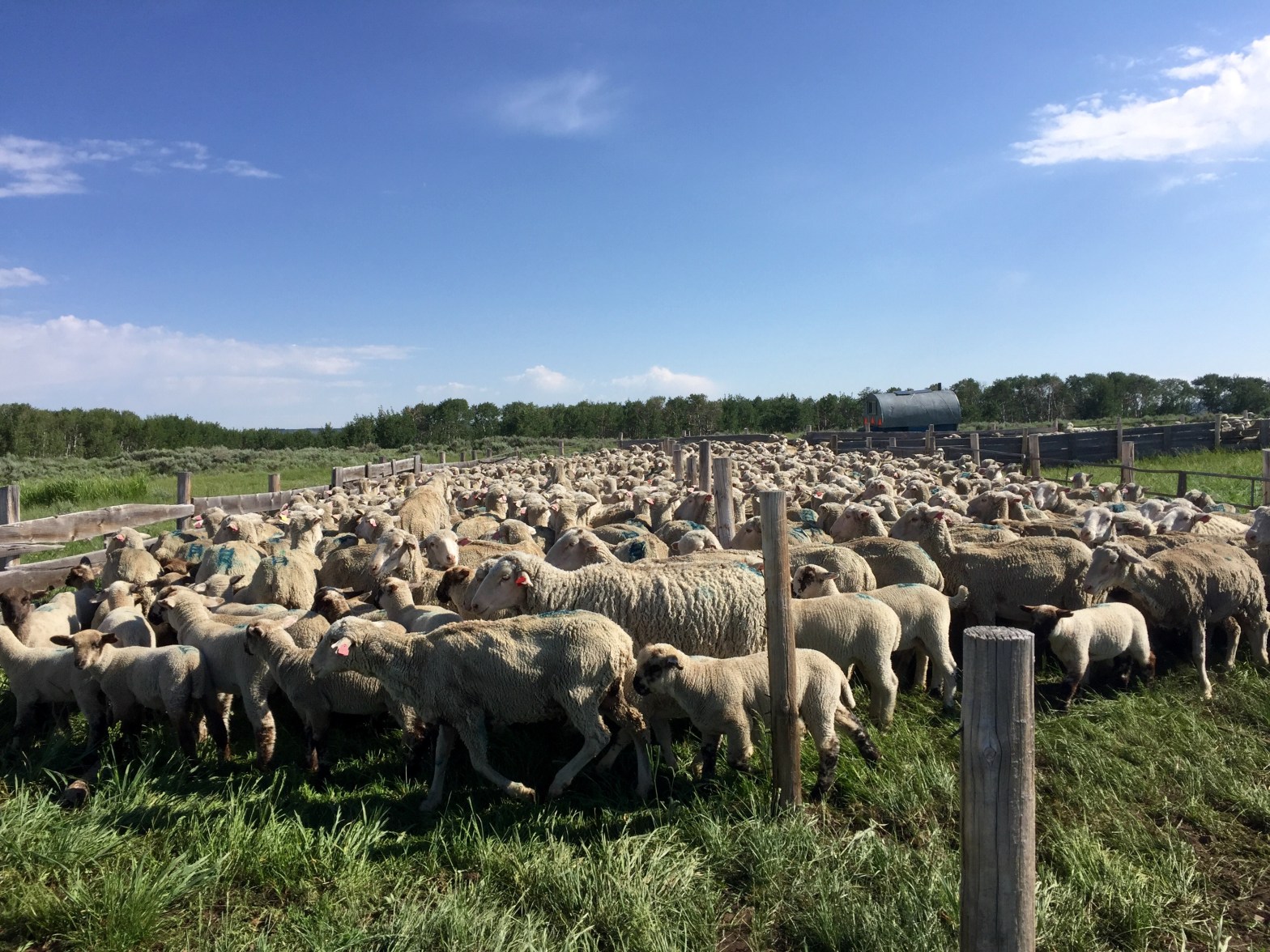
On Monday, we did the second to last docking for the lambs! After they finished docking on Tuesday, the sheep herders (beginning with the first docking group) began the long trail to where the sheep will spend their summer on the forest permits! Before they begin to officially trail the groups onto the forest, all herds must be run through what they call the “government corrals” which are located on one of their BLM forest permits. At the government corrals we run the sheep through a shoot to count all ewes and lambs and we also separated off about 30-45 ewes to act as “count” ewes. The count ewes are separated off randomly out of the herd as they run through the shoot. It is important not to take the first 30 ewes or the middle/last 30 due to their “clique-like” social patterns. When you take a random ewe every 20-50 ewes you’re going to have a better count on your herd! The count ewes are paint branded with numbers to correspond to the number of ewes in the herd! Each herd has anywhere from 400-900 ewes!

This week was also the stewardship tour in Sheridan at the Kane family ranch! So 3 of the 7 days were spent either traveling or being on the tour!

Back at the ranch, my mentor Ea’mon and the local vet went out to their desert ranch (Powder) and did BSE testing on their yearling bulls! BSE stands for Breeding Soundness Exam, where they score a bull’s reproductive health based on several criteria items such as scrotal circumference and sperm motility.

After we returned from Sheridan, we got right back to work! It was right in time to pull the CIDRS we put in last week and to give all the cows shots of Lutalyse so we can breed them this upcoming week! When we went to gather the group of 300 mother cows, we had some issues with getting them into the corrals. We ended up experiencing a pretty big blow-back with the herd which resulted in having to re-gather the cows a couple of times! Our final attempt was primarily successful due to moving slow and making sure we made very precise moves! This is definitely something I have never experienced while gathering cows on horseback so it was certainly a unique opportunity and learning experience! By the time we started to pull the CIDRS and get the cows shots and new ear tags it was right around 6pm! We didn’t end up finishing until 10:30 that night! Needless to say there was no moon and we had to both finish everything in the dark and ride our only mode of transportation (the horses) back to the main ranch! Let’s just say that my horse is more afraid of the dark than I am!

We ended the week out by pulling the CIDRS in the heifers at 6am on Sunday morning! Everything went really smooth and we ended up finishing the 79 heifers in only 40 minutes or so! Thank goodness because I was FREEZING!

We are still really busy here at Ladder but I am thankful to be learning all the things that I am!

Bum Lambs nursing on a guard dog


Josiah the Irrigator

Josiah Masie is a returning Rangeland Intern, so his name may sound familiar. We are happy to have him back this summer. He explains that “Irrigating has become my life” in his weekly summary for last week. Josiah also explains what irrigating has to do with range management and his take on what is learning on the ranch is great! Check it out below. 

First things first, irrigating has become my life. It’s a constant chore to move dams, close gates, and irrigate across the fields as quickly as possible while still making sure everything is getting wet. There are some fields where I can move the dam 4 or 5 times a day, which is a lot for me, since I’m used to most being twice a day.

I figured I would talk about irrigating little though, just because one of my friends asked me what it had to do with rangeland management, and building off of that what it has to do with the internship. So this is what I told him and why I think it is important part of my internship: Irrigating is boring, tedious, and worst of all repetitive, but it is essential to maintaining healthy rangeland on ranches. No I don’t water the rangeland, or really affect it directly, but what I am doing is growing lush healthy meadows that 1) provide hay and feed, and 2) an alternative food source for our cattle and the wildlife around the ranch, other than just the range. A great example of this actually occurred this year… with the random weather and cold temperatures till the beginning of June, there was essentially no grass on our summer ranges for the cows to eat. However, instead of sending the cows up there when they planned and letting them over graze the area, they kept them in the meadows for an extra two and a half weeks to allow the grass to grow on the mountains, so that over grazing wouldn’t occur. When it comes to range management it is important to have these kinds of alternatives available in case of problems like that one. So I don’t really think of irrigating as a tool for farming, but as a method to preserving rangeland.

I’ll get off my soap box now and tell you about the week. Like I said plenty of irrigating, I’ve also been fixing some fence, and all the usual stuff. There has been a ton of rattlesnakes out lately, I guess it finally got consistently warm enough for them, so that has not been very fun to deal with. Thursday I went to a Sage Grouse symposium where I learned a bunch. Surprisingly there was actually a lot of talk about range management and how it can benefit the grouse… I wasn’t really expecting there to be very much about it but there was. I found a beaver skull in one of the creeks this week, so that was cool. It has been hitting up into the 90’s temperature wise all week so that has not been cool, and really that about it for the week.
The Farm Paparazzi

Armed with an automatic setting to expose a happy life full of God's grace

Facts About Beef

Debunking myths about beef

Beef Runner

Agriculture Advocacy, Beef and Running

Wyoming Lifestyle Magzine

a virtual visit to wyoming's rural communities

Wyoming Livestock Roundup

a virtual visit to wyoming's rural communities

Bridle-Bit LLC Blog

Horse & Rider Training. Serving The Northern Front Range Since 1981

Faces of Agriculture

a virtual visit to wyoming's rural communities

The 307 Chronicles

a virtual visit to wyoming's rural communities

Wyoming Roundup

a virtual visit to wyoming's rural communities

a virtual visit to wyoming's rural communities

Double H Photography

a virtual visit to wyoming's rural communities

Ladder Ranch

Scenes, thoughts and poetry from our working ranch

Comedy Of A Cowgirl

The Comedy of Storytelling

RealRanchers.com

a virtual visit to wyoming's rural communities