While touring the Jonah Field in Pinedale, Wyo. with Encana Oil & Gas (USA) Inc., we had the opportunity to tour a working drilling rig. You can read more about my trip to the Jonah Field in my first post.
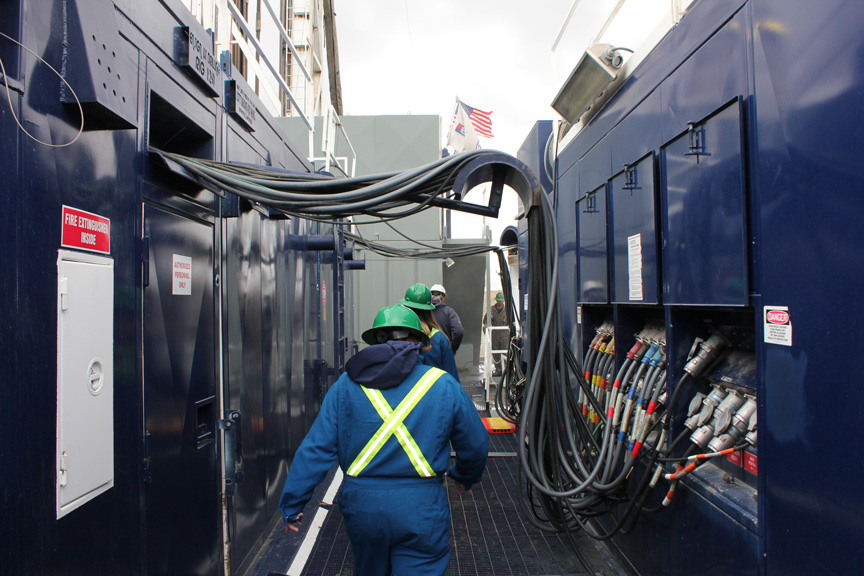
Above is Rig 129 on the Jonah Field. Each drilling rig in the United States has a unique, assigned number. I was interested to learn that the rig runs directly off of the natural gas from a nearby producing well. The use of natural gas reduces air emissions by a whopping 50% when compared to using diesel fuel.
Here we all are, dressed to the nine’s in our FRCs and PPEs (fire retardant clothing and personal protection equipment). Robert Samples, the drilling supervisor, spoke to us about the particulars, science and safety behind drilling for oil and gas.
It takes approximately 15 days or less to drill each well. Encana and other energy companies often employ directional drilling, which allows one rig to access multiple gas reservoirs from one drilling location. This greatly reduces the environmental footprint. Oil and gas companies such as Encana are constantly discovering and implementing new and better technologies that reduce environmental impact and increase worker safety. What’s better for the environment and for energy workers, is better for the companies’ sustainability.
Now we’re headed into the control room on the oil and gas drilling rig.
The control room looks a lot like how I imagine the inside of a space shuttle would appear. The rigs are automated with Iron Roughnecks and Iron Derrickmen, which reduces manual handling of pipe and increases safety for Encana workers.
This system carefully monitors many variables while the drill operates. It shows depth, drilling speed, pressure and more. The control room operator has a lot to monitor!
Typical drilling locations impact only five acres of land and support multiple wells from the same site. The tour guides also reported that a rig in Colorado was able to serve 52 wells from the same pad. Now that’s progress!
EDITOR’S NOTE: On a ranch, everyone in the family has a job to do according to their skills and abilities. On her blog, RealRancher Heather Hamilton shares a job her sister, Holly, is in charge of as part of their hay transportation operation.
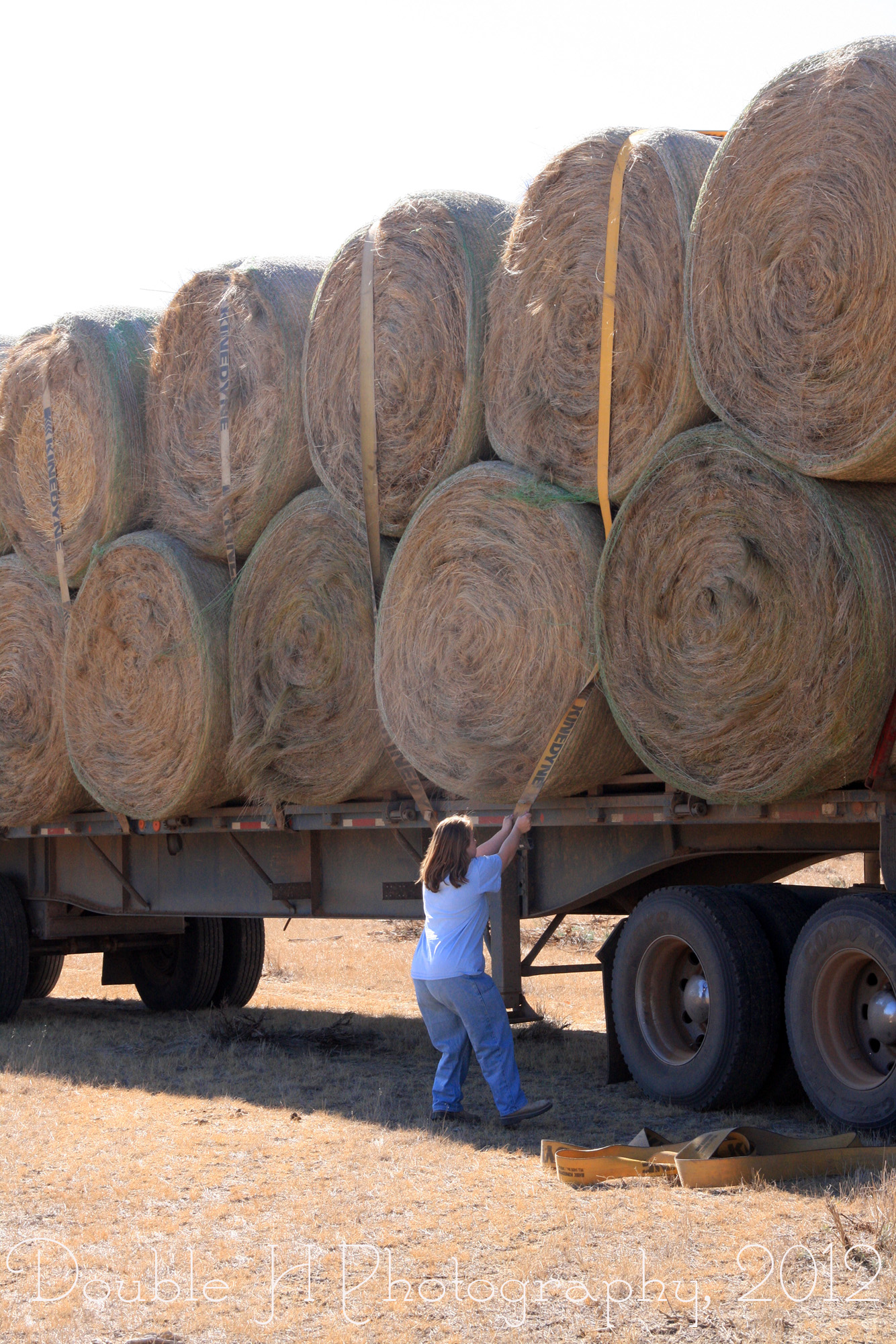
Among Holly’s jobs around here are rolling straps as often as possible when the guys bring a load of hay to our place. She enjoys the task, and generally is happy to go along with about anything trucking related. Here she is headed down the stack corral with my brother this evening.
Here she is a few days ago, with another load. As dad or Kyle unhooks the straps on one side, Holly begins pulling them out on the opposite side.
Fencing is a fall and spring job that has to be done on a ranch. It is part of fall and spring housekeeping. Fences have to be fixed to keep the cattle where they belong and to manage the land so the land is not over used.
RealRancher Albert Sommers and Nikki Marincic fix and build fence around hay corrals on the Sommers ranch near Pinedale, Wyo.
Fencing became an important and needed part of the ranches in the Green River Valley after the “Equalizer Winter” of 1889-90. The ranchers had to fence their irrigated hay meadows to keep the cows off of them so the hay crop could be grown and put into stacks for winter feed. William Sutton on the Bootjack Ranch was the first rancher to fence his ranch in the Upper Country in 1897.
Nikki staples wire in place on the hay corral fence.
Ranchers have to fix fences around the outside of the ranch along with cross fences to make different pastures to manage the cattle. Fences around the haystacks also have to be fixed so the cattle cannot get into the hay until the ranchers are ready to feed them the desired amount each day. Corral fences are other fences that have to be mended.
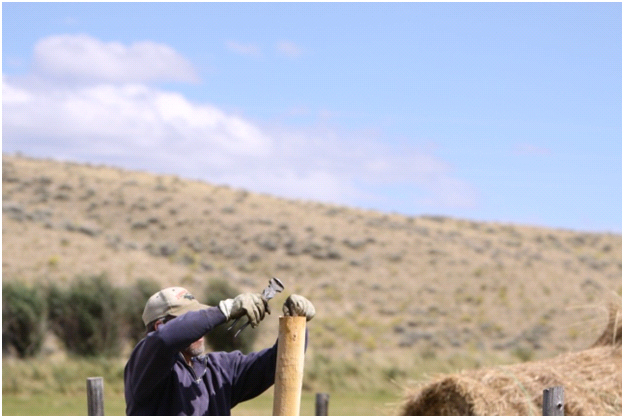
Albert uses fence stretchers to stretch the wire tight.Albert twists wire around gate posts.Albert uses his wire pliers to twist wire on his hay corral fence.
In the fall, hay corrals are fenced after the hay has been put in them. Many ranchers mend the cross fences and go around the outside fences in the fall too. In the spring, outside fences are repaired along with the bull pasture fences. The bull pasture is where the bulls are kept until it is time to start the calving window in the cows. Spring and summer pastures are fenced as soon as the snow is gone and the frost is out of the ground before the cattle are turned out on grazing allotments or pastures.
The truck holds all the fencing supplies while Albert & Nikki work on the fence. While this fence is relatively short, ranchers often fix and build miles and miles of fence each year.
Wildlife-friendly fences are desired today. This is a fence with three or four wires and 40 to 42 inches high with the bottom wire 16 to 18 from the ground. Many of the old ranch fences are wildlife friendly because the rancher could not afford anymore wire than three wires.
Albert uses a crowbar to break the dirt up so he can more easily dig a post hole.Albert uses a post maul to pound fence posts into the ground.
There are all kinds of fences. There are three, four and even five wire fences. There are woven wire fences which are used mostly with sheep. There are buck fence, pole fence and wire fence with a pole on top.
Albert pounds a bent fencing staple flat so he can use it again.Albert pounds a staple into a post to hold the fence wire in place.
Driving posts, twisting wire and pounding staples are all part of fencing. Post malls, crowbars, fence stretchers, wire pliers, barb wire, smooth wire and staples are the needed tools. Any time you see a pickup with posts, wire and other tools, the rancher is off to mend the fences, which is a never ending job.
From RealRancher Jonita Sommers – Pinedale, Wyo.
Wyoming ranchers Dudley and Marilyn Mackey live in Gillette, Wyo. where they are involved in both ranching and energy work. Marilyn’s family homesteaded the ranch in 1917 and she and Dudley are now the 4th generation on the ranch, running in a partnership with her parents, Marion & Mary Scott. The Mackey’s run Red Angus cattle and have dryland hay.
They have two children, their son lives on the ranch with his family and their daughter and her family live a couple miles down the road on a different part of the ranch. All of the family is involved and helps in every aspect of ranching. As is the case for many Wyoming ranchers, Dudley also works at the Belle Ayr coal mine and their son works for WPX Energy.
Mackey’s Red Angus calves are waiting to get water
Marilyn and Dudley bought the ranch in 2000 and they started working with the energy industry on their ranch because of the presence of Coal Bed Methane (CBM). They worked with the CBM companies in designing a pipeline watering system which added additional cattle watering tanks and reservoirs throughout the ranch. This benefited the ranch a great deal during several years of drought with a better water supply for cattle, enabled better utilization of grass and added pasture rotation capabilities.
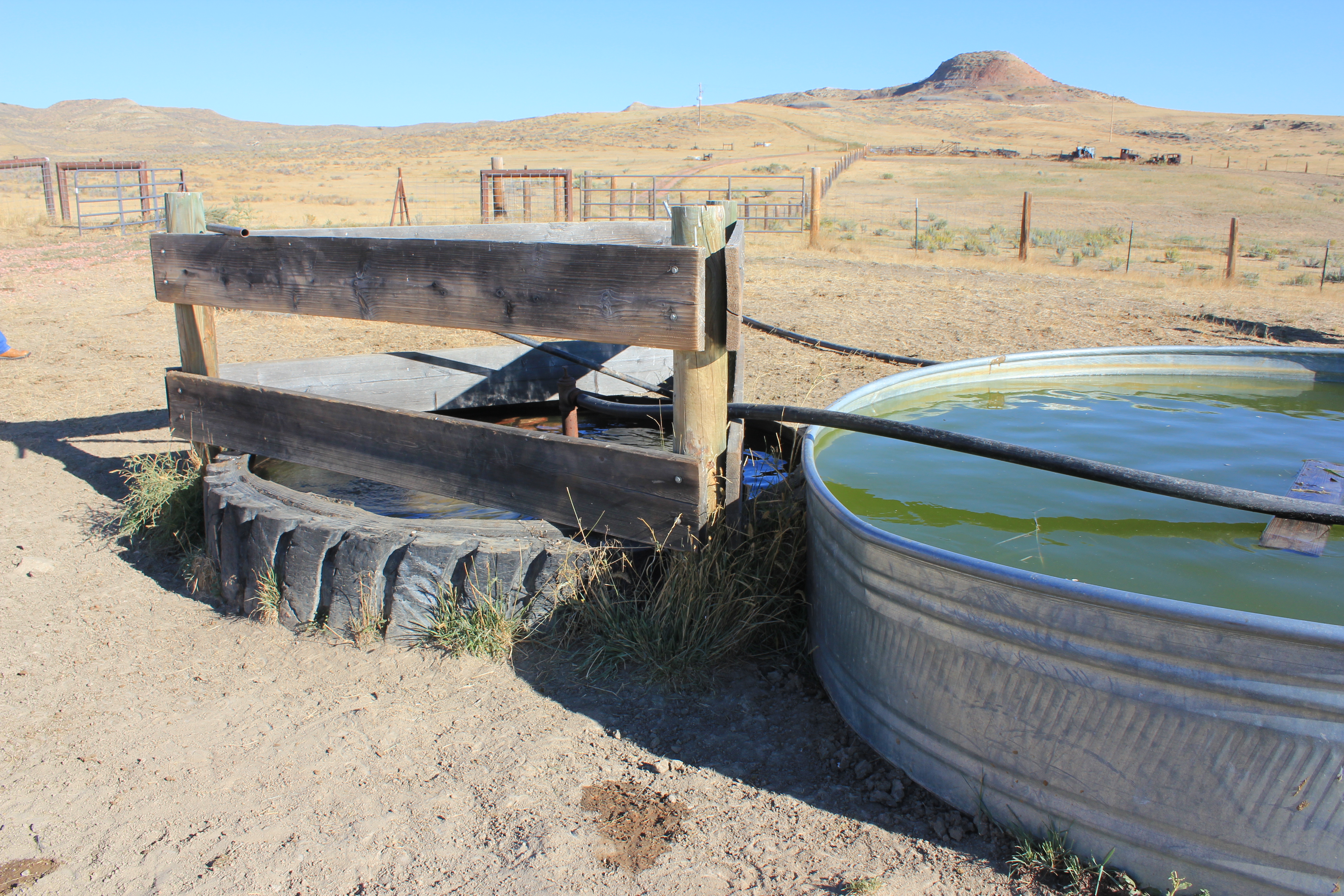
The pipeline developed from the CBM wells is connected to the livestock watering tankMarilyn Mackey is turning off the water so the tank stops filling
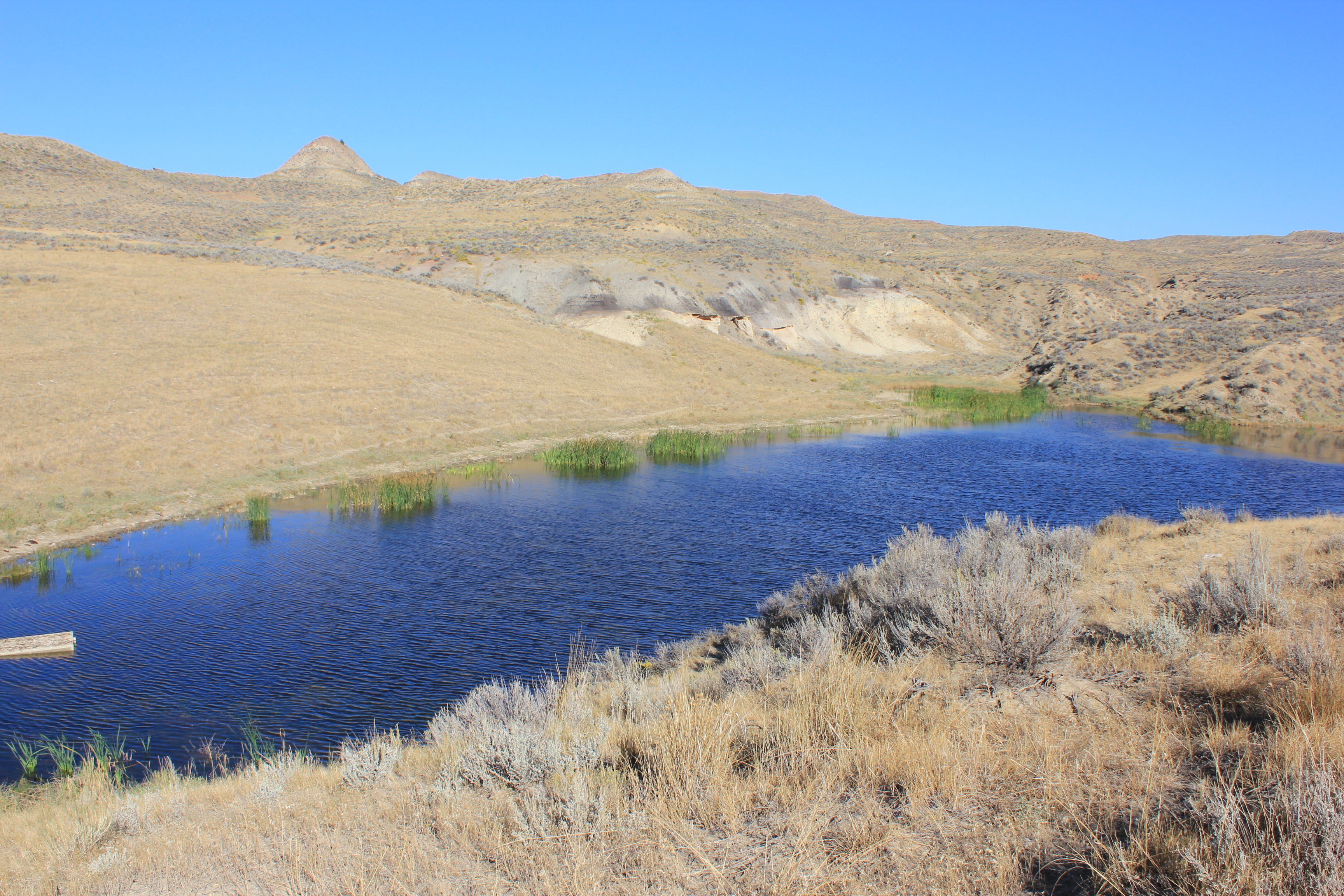
One of the biggest reservoirs on the ranch is connected to the pipeline watering system and the runoff from the water tanks feeds back into the reservoir through a grate and travels down a rock path to the reservoir. The rock path is used to prevent water erosion on the pasture.
The cement grate is used to collect water runoff and return it to the reservoirThis rock path is connected to the cement grate. The water travels down the path to prevent water erosionThe Coal Bed Methane reservoir on the Mackey Ranch
Some people claim that CBM reservoirs are bad for the soil and the plant life near the water. This isn’t true on the Mackey Ranch. On one of the dried up reservoirs there are Cottonwood trees growing along with other grasses. On the ranch there have been no problems with CBM reservoirs and they have proven to be beneficial.
A dried up reservoir where new Cottonwood trees are growing
On the ranch the Mackey’s work with five different energy companies: Williams, Pinnacle Gas (now Summit Resources), Red Stone (now Luca Technologies), Yates and Devon. The Mackey’s have had good experiences working with the energy industry. For example, the CBM companies made big improvements to the roads on the ranch, making it easier to travel through the pastures in all kinds of weather. The Mackey’s worked with one of the companies to design and build a water storage system using CBM water for livestock and household use at the main ranch facilities. The CBM water was of better quality and quantity than their existing well and enabled them to plant and water new shelter belt trees as well as improve household lawns and livestock watering systems.
In Wyoming, the energy and agriculture industries are very intertwined. Not every interaction between ranchers and energy companies is positive, but when both parties are able to work together, they can ensure food and fuel production keeps the world running.
Story told by WSGA Intern Brittany Schaneman following a visit with RealRanchers Dudley and Marilyn Mackey – Gillette, Wyo.
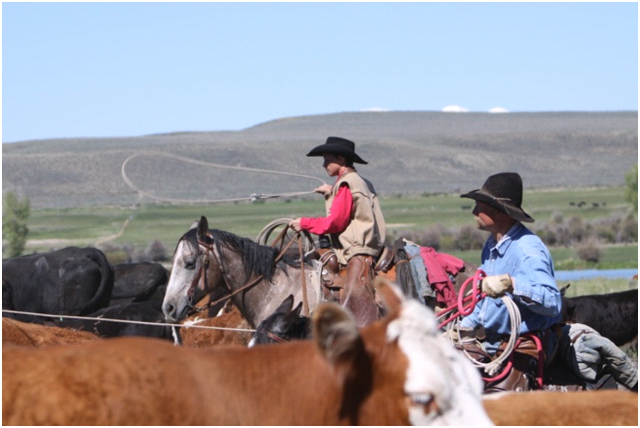
With the bite of winter cold in the air, the cowboy steps up on a horse to gather the cattle. The dawn light breaks over the sky and the breath of each animal is visible. All of the neighbors are at the ranch to help with this work, just as all the ranchers will be at another neighbor’s ranch in a few days to help. The ranching community relies on neighbors’ helping with fall cow work. If this circle is broken because a ranch has been sold and the new neighbors do not understand the century-old tradition, it is a burden that ranchers from other circles have to help carry.
Once the cattle are brought to the corrals the work begins. It may be a day to vaccinate calves, wean calves, pregnancy check cows and heifers, or ship the steers and heifers to market. Once the routine of working the cattle starts, the ranchers begin visiting and joking with each other. The drudgery of work is made fun with all the neighbors.
Jamie Swain and Albert Sommers vaccinating and Charles Price putting a pour-on parasite control on a calf.
If it is shipping day, the steers and heifers are weighed on site or transported to the neighbor’s scales. The cattle are sold by the pound to a feedlot where they are “finished” on a diet of hay, corn silage, grains and supplements. Care is taken to get the cattle across the scales as stress-free as possible because stress causes weight loss. Once the cattle are across the scales, the semi trucks roll into the ranch yard, the cattle are loaded and a convoy of semis head down the road. A whole year’s worth of work is rolling out the gate. Ranchers only have one major pay day and this is it. They send cull cattle (cattle no longer suited for the rancher’s herd program) to auction barns too, but the bulk of the income is from the calf or yearling crop.
Semi trucks are used to haul beef cattle to the feedlot.RealRancher Albert Sommers runs the cattle scales that weigh the cattle before they are shipped to a feedlot.
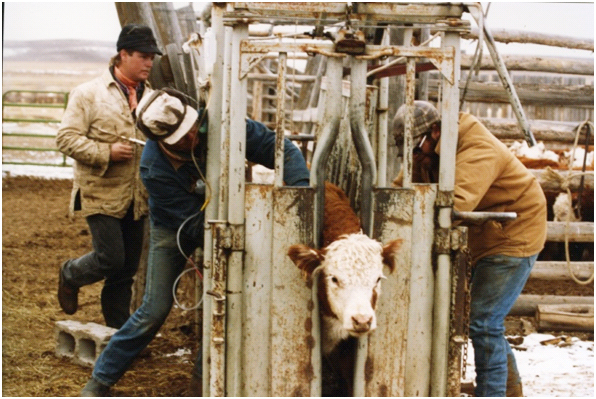
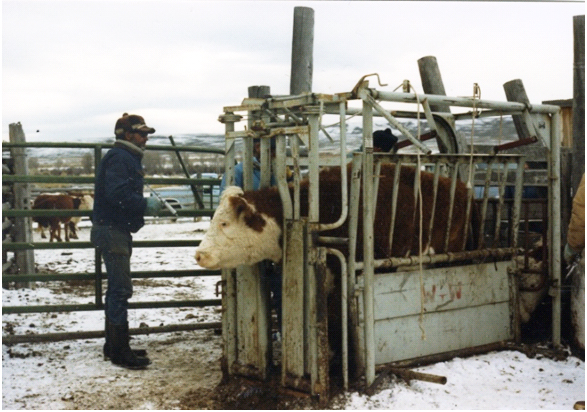
If the purpose of the day is to vaccinate calves, the calves are separated from their mother cows and are run through the chute for vaccinations. This is a calf’s second set of childhood vaccination shots for diseases. They are given shots for pneumonia, black leg and brucellosis. In about two weeks, the calves will be weaned from their mothers after the inoculations have had time to increase the calves’ immunity. The cows are separated from the calves. The calves are left in the corral and the cows go back to pasture. Now the rancher hopes the fencing job will hold. Once the cows and calves have been separated for a week, they don’t try to get together any more. The calves are now becoming young adults. This gives the mother cows five months to get ready for their new calf.
Vern Aultmn, DVM, attaches a tag that shows the cow has been vaccinated against brucellosis, a disease that causes cows to abort.
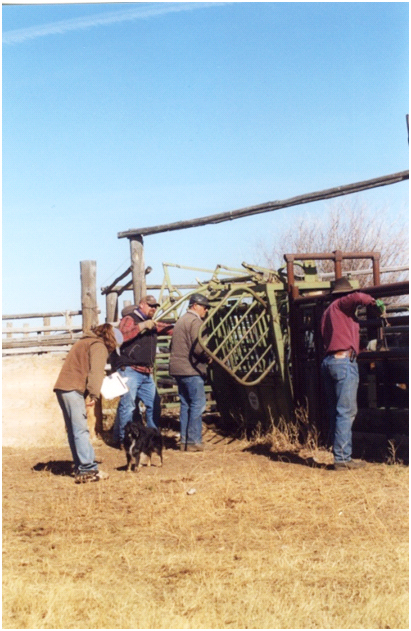
Once the calves are weaned, the cows are “preg checked.” Sometimes, ranchers pregnancy check before they wean. The cows are run through the chute and the veterinarian checks to see if the cow will calve within the calving window, which is usually a two-month period. A cow cycles to be bred every three weeks, so this allows for two breeding cycles. If the window is kept at two months, the calves are all a more uniform size when they are ready to be shipped. Some ranchers will remove the bulls from the cow pasture to better regulate the calving window. This way the rancher does not depend so much upon the vet’s input as to date of birth. The cows are also given their yearly vaccinations and a pour-on liquid is used to get rid of lice and worms. The cows’ eyes, feet and teeth are checked. If the cow passes all the tests, she is good to go for another year. If she doesn’t pass a test, she becomes a “cull” cow and is shipped to a sale barn.
“Preg checking” determines if the cow is pregnant or “open”. It also helps determine the cow’s due date.
The heifers that are almost two years old are usually tested a different day. The rancher picks the “replacement heifers” which are pregnant with their first calf. These heifers either add to the herd or replace culled cows. The rancher sorts out the best heifers and pregnancy checks them. If they are going to calve in the two-month window, they are kept. After the veterinarian has given the thumbs up, the heifer is given her yearly vaccinations for vibrio and lepto along with the pour-on.
Nikki Marincic tallys heifers, Chuck Bacheller runs the chute, Charles Price vaccinates the cows and Michael Klaren works the alleyway.
The bulls have to be “trich tested.” The veterinarian does this test. Trichomoniasis is a venereal disease that bulls retain and pass on to the cow causing her to abort her calf. Bulls have to be tested if they run in a common allotment (the same land shared by multiple ranches for grazing) with other ranchers’ cattle or when nonvirgin bulls are sold for breeding purposes.
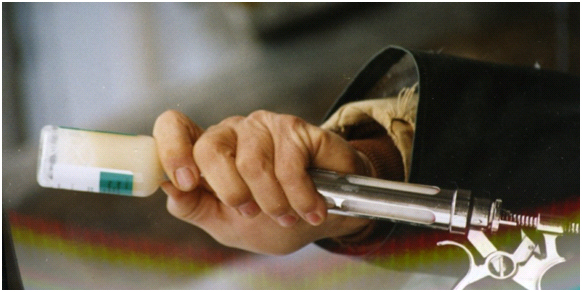
Preparing the vaccinating gun for calves.
Once all of this cow work is done, the cows are ready for winter. Everyone who comes to help the rancher work the cows especially enjoy the end of the work day. They all go to the house and sit down to a feast which is much like a Thanksgiving dinner.
A proverb tells us “from small beginnings come great things,” and this was the case with the Jonah Field. As you will recall from my first RealEnergy post, I was a part of a tour of this vast and productive oil and gas field near Pinedale, Wyo. last fall. Wyoming historian Ann Chambers Noble was on hand to give the tour participants an overview of the Jonah Field’s beginnings. It was wonderful to visit with Ann on the tour. She is a marvelous resource and has carefully documented a lot of important Wyoming history. Read her article on the Jonah Field and Pinedale Anticline, and check out her book Hurry McMurry on Neil McMurry who was the man behind the success of Jonah.
Roaring of motors in August is a common sound in the hay fields of the Green River Valley. Tractors moving in the hay fields around the hay stack are like ants busy at work around their ant hill. Green grass turning different shades of green as the hay is cut, baled and stacked is a typical site on Green River Valley ranches.
The cutter bars are folded up on a double-nine-foot mowing machine.
August is haying time in the Green River Valley. Some people start the latter part of July and some end the haying operation in September, but the bulk of the hay is put up in August.
The cutter bars on the mower are lowered to cut the native-grass-hay pasture.
Haying began in the Green River Valley earnestly after the “Equalizer Winter” of 1889-90 when 90 percent of the cattle died because the snow and ice was so deep the cattle could not get to feed and no hay had been put up to supplement them. A few ranchers put up a little hay for the horses and milk cows kept in the corrals, but nothing to save the herds.
Cutting the native-grass-hay pasture.
Now, every ranch, which winters cattle, puts up hay to feed those cattle in the winter. When the ranchers first started putting up hay it was put up in loose hay stacks like Campbells still do in the Hoback Basin. The early ranchers stacked the hay with nets and dropped the hay on the stack. The overshot stacker soon became the fashion where the hay was more or less thrown onto the stack with a big wooden fork like a catapult. The beaver slide with the plunger to push the hay up the slide to the stack was the third way hay was put in the stack. Balers came into fashion in the 1950s and 1960s in the Green River Valley. They really became part of the haying operation in the United States in the 1940s. However, many people still stacked loose hay. Then big square and round balers were developed. The first round baler did not see production until 1947, when Allis-Chalmers introduced the Roto-Baler and it ended in 1960. The next major innovation came in 1972, when the Vermeer Company began selling the first modern round baler. Previously, round hay bales had been little more than lumps of grass tied together, but the Vermeer design used belts to compact hay into a cylindrical shape as is seen today. In 1978, Hesston developed the first 4×4 square baler of its kind. By the 21st Century, only one family in the area still stacked loosed hay. You mostly see big round bales today.
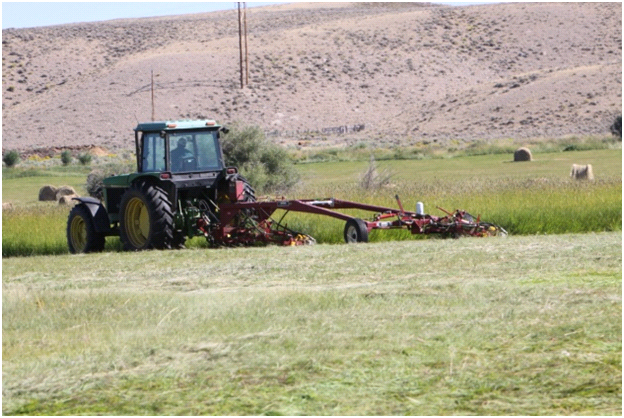
Hay is cut by a mower…but, it’s a lot bigger than your riding lawn mower.
The hay has to be mowed down with a sickle or drum mower or a swather. Once the hay is cut it has to “cure,” to reduce the moisture level, so it will not mold or ignite into a fire when it is baled and stacked. “Cured” hay needs to have very little moisture and the stems snap when bent by the hands of a rancher. It usually takes about 1 to 2 days for the hay lying on the ground to be cured enough to be baled in the Green River Valley. The humidity and wind play a large role in how the hay cures.
Joey Cook rakes the hay into windrows.
The ranchers do not want it to rain on the hay because the rain can cause the hay to lose its protein and reduce the feed value. The ranchers want to put the hay up so it will have has as much protein value as possible but will not mold because it is too wet.
The hay rake moves the swathes of hay into “windrows”, which make the hay accessible to the baler.
Once the hay is “cured,” it is raked and a baler goes down the windrow of hay. The balers have computers today telling when the bale is the correct size. Balers tie the bales with plastic twine or sisal twine. Sisal is a natural fiber that decays over time.
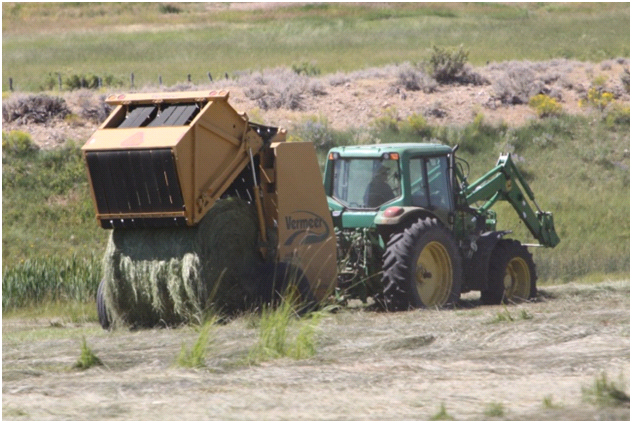
The tractor pulls a baler to pick up the windrow of hay to bale
After the hay is baled, it is stacked in hay corrals or stack yards so the cattle cannot eat it until the rancher is ready to feed them.
After the baler ties the hay with twine, the bale gets kicked out of the machine.
Watching for the songbirds and swamp birds so they can be chased out of the way is a fun part of haying. The hawks are awesome. The hawks love haying and it is especially important for the young hawks. The hawks follow along behind and rake or baler and watch for mice.
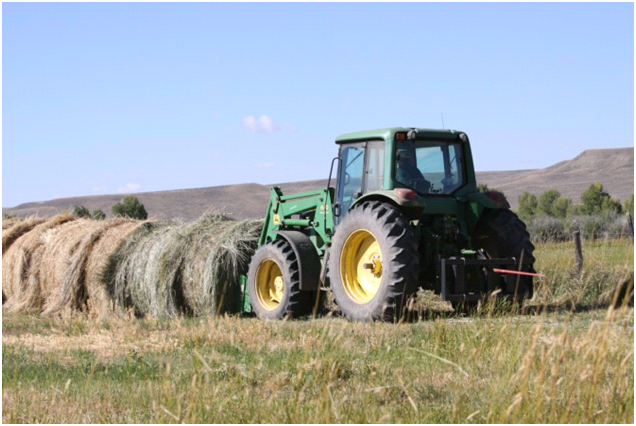
The round hay bales are picked up with a fork loader and carried to the stack yard for storage.
Once a mouse is spotted the hawk dives for its prey. When haying starts, you know summer is about over and fall is soon to follow. Soon the hay will have to be fed to the cows during the winter months.
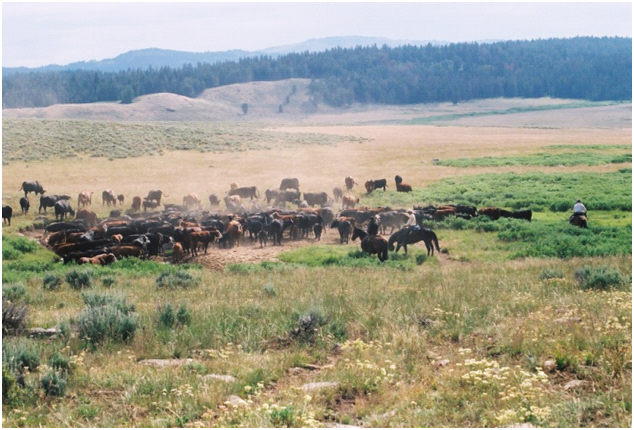
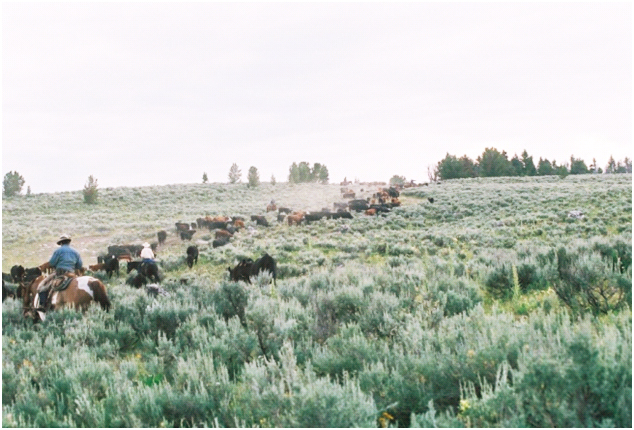
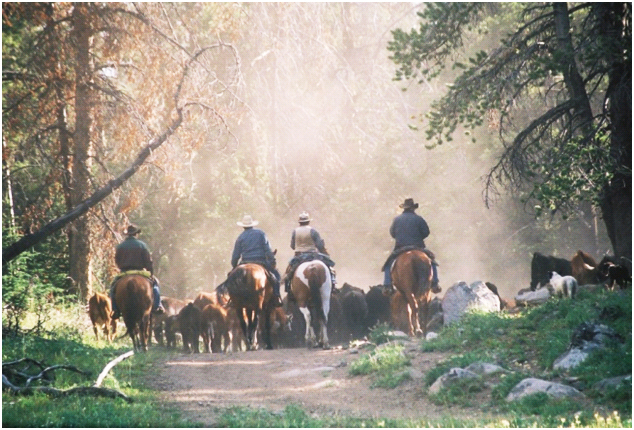
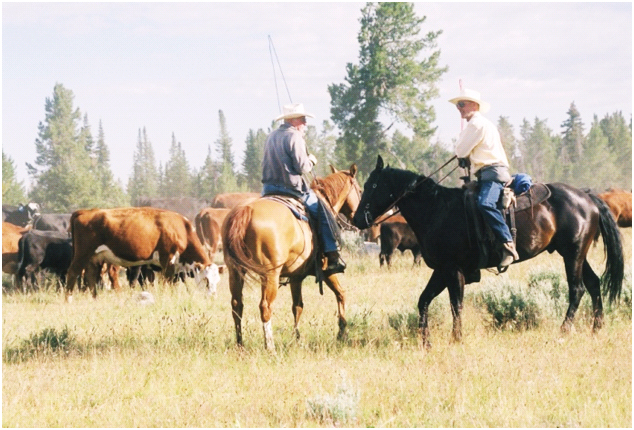
The sun starts to lighten the skyline above the Wind River Mountains while the song birds can be heard singing and the warm and cool air currents can be felt as the cowboys ride across the sagebrush, BLM allotment to gather the cattle and start them marching north to summer pasture. This is the beginning of summer in the Green River Valley. This is the scene from the middle of June to the first part of July on the Bureau of Land Management (BLM) grazing allotments in the Green River Valley. The cattle are methodically gathered and put on the trail to the summer pasture in the mountains on Forest Service land or private. The cattle are trailed anywhere from 10 miles to 70 miles depending on the summer grazing pastures.
Bobby Gilbank and Eddie Wardell putting cattle into Fish Creek Park.
The first Forest Service grazing permits were issued in 1906. To get a permit at this time, a rancher had to have a ranch in the area and to have used the open range in the last three years. Starting in the 1930s, the cattle were counted by the Forest Service to see how many head each rancher was putting on the Forest Service grazing allotment.
Bringing cattle off of the Mesa into the Hennick Draw while moving cattle to the mountains.
Starting in 1970s, more intensive grazing systems were developed, so the cattle could be grazed to benefit the grass. Much of the land was at too high an altitude to have rest-rotation pasture systems, so deferred grazing pasture systems were developed. A deferred grazing system describes the process by which cattle enter the foothills of a pasture system in the spring and migrate to the high country and then drift down the other side to a low pasture in the fall. The following year cattle use the opposite low pasture first and out the other pasture in the fall. This allows the grass a recovery time. A rest rotation grazing system consists of four pastures, which works by resting one pasture every year while the other three are grazed. The rested pasture is rotated every year.
Tanner Butner and Michael Klaren doctor calves on the way to the mountains.
The 1980s saw riparian areas being part of a concerted effort to improve the stream bank life. Beginning in the 1990s, range monitoring was done in cooperation with the ranchers, forest service range conservationists and the University of Wyoming’s county extension agent and range specialists.
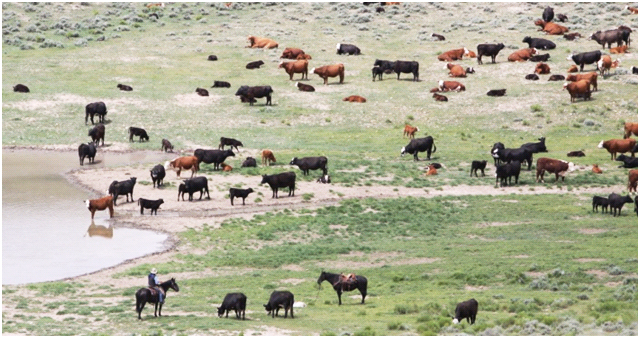
The ranchers stop their cattle herd at the Blue Reservoir after coming off the Desert.
By the late 1990s and early 2000s, cows and the ranchers began dealing with the grizzly bears and wolves killing livestock. It is hard to see a calf mauled and suffering or a cow bawling for her dead calf. Some cows have been killed by the predators when protecting their young.
Keith Murphy moves cows up Pinon Ridge to Fish Creek Park.
The cows are monitored by a cowboy or cowboys in each pasture system. The cattle are moved to a new pasture as the grass is used and new grass is needed. Many of the old cows know where their favorite spots in the mountains are located, so they will grab their calf and take off to enjoy the mountain pasture.
Jamie Swain, Keith Murphy and Garlie Swain taking cattle into Fish Creek Park.
It is always fun to move the cows to the new pasture. The growth of the calves can be seen. Beautiful mountain scenery, fresh crisp mountain air, beautiful wildflowers, cow and calf elk mingling with the cows, moose along the river bottom in the willows, deer and antelope throughout the pasture are seen during the cow drive.
Albert Sommers brings cattle out of the Hennick Draw.
Some ranchers have private allotments in the foothills and haul or drive their cattle to and from the private pasture. This is for another story.
Sprout and Eddie Wardell move cows into Fish Creek Park.
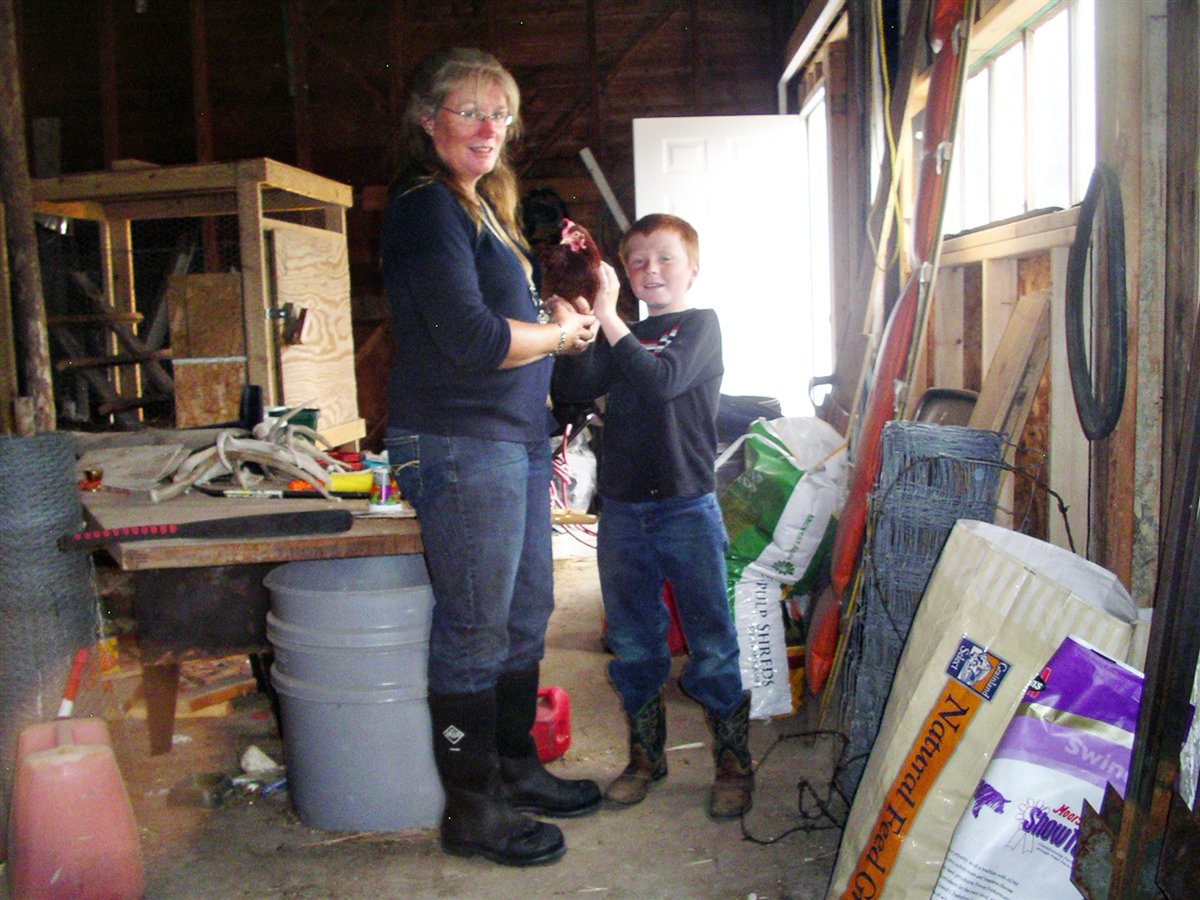
EDITOR’S NOTE:In honor of the launch of RealEnergy on RealRanchers.com, The Original Muck Boot Company and RealRanchers.com gave away four pairs of The Chore boots on our Facebook page in July. One of the winners responded kindly to our request for photos of her wearing her prize. Thanks for the contribution Gail and kids!
The Muck Boots arrived sometime last week while I was at the Carbon County Fair with my first-year 4Her. They are great!! My kids are 9 and 7 years old and when I told them you asked for a picture of me in them, they followed me around with the camera while we did chores.
Chores have been a twice daily ritual for the three of us since they were tiny. My husband cowboys on a large ranch, so we have always helped with bottle calves and other critters with special needs. The chickens are one of my son’s 4H projects this year.
Thanks again for the Muck Boots—they will be worn daily and are much appreciated!
EDITOR’S NOTE: Due to the fault of this busy editor, I didn’t get this wonderful post up in a timely manner, but it’s just too good to wait until next spring to share. So here is Katie’s Spring 2012 experience…even though it’s August. Thanks for putting up with me. – LL
Spring time!! The grass has sprung and the cows are chasing the green stuff like crazy! Time to put away the snow machines and bring down the horses from winter pasture.
In the spring we stop feeding hay to our cattle. We gather up the cows, sort them into groups and trail them to the summer pastures!
Also in the spring is when our registered cows start popping out those cute little baby calves.
And those cute babies become a big job! They have to be weighed, tagged and given a shot.
Another big job in the spring is fence building. We go around the fence lines and fix the holes.
It sure doesn’t seem like much, but oh boy its a 24/7 job!



























 RealRanchers.com